Serving Hillsboro & all of Washington County, OR Free estimates: (971) 397-9361
Hillsboro Excavation Co.

Home › Cornelius

Demolition in Cornelius, OR

Demolition in Cornelius means working feet from a neighbor’s wall, not in an open field — access, barriers, and debris routing have to be planned before equipment arrives.

Licensed & insured in Oregon Free on-site estimates Local Washington County crew Wet-season ready

Demolition on a residential lot in Cornelius is not the same job as a teardown on a rural acre. The lots here are small, the neighbors are close, and the machine that can reach the structure may not fit through the gate. Hillsboro Excavation Co. handles demolition inside Cornelius where the planning work—access, barriers, utility coordination, and haul routing—takes as much thought as the actual teardown. Getting it right means every neighboring property stays undamaged from start to finish.

Cornelius covers 2.340 square miles and holds 4,843 households. That density produces short setbacks: a structure being removed may stand only a few feet from the neighbor’s foundation, siding, or shared fence. Washington County ground is largely silty clay, which holds moisture well into spring and compresses under equipment loads during wet months. On a tight Cornelius lot, the soft-ground season matters because there is often no haul route that avoids the neighbor’s driveway or the soft strip next to the fence line. Choosing the right time of year is part of protecting adjacent property, not just the owner’s own soil.

Utility corridors in dense residential areas also tend to run closer to the surface than contractors encounter on rural sites. Gas, electric, water, and telecom lines serving multiple homes often share the same trench near the street, and a demo machine working toward a foundation can encounter a live lateral before anyone expects it. Locating those lines before demolition starts—through the state 811 call-before-you-dig service and direct coordination with each utility provider—is not optional. It is the step that keeps a residential teardown from becoming an emergency.
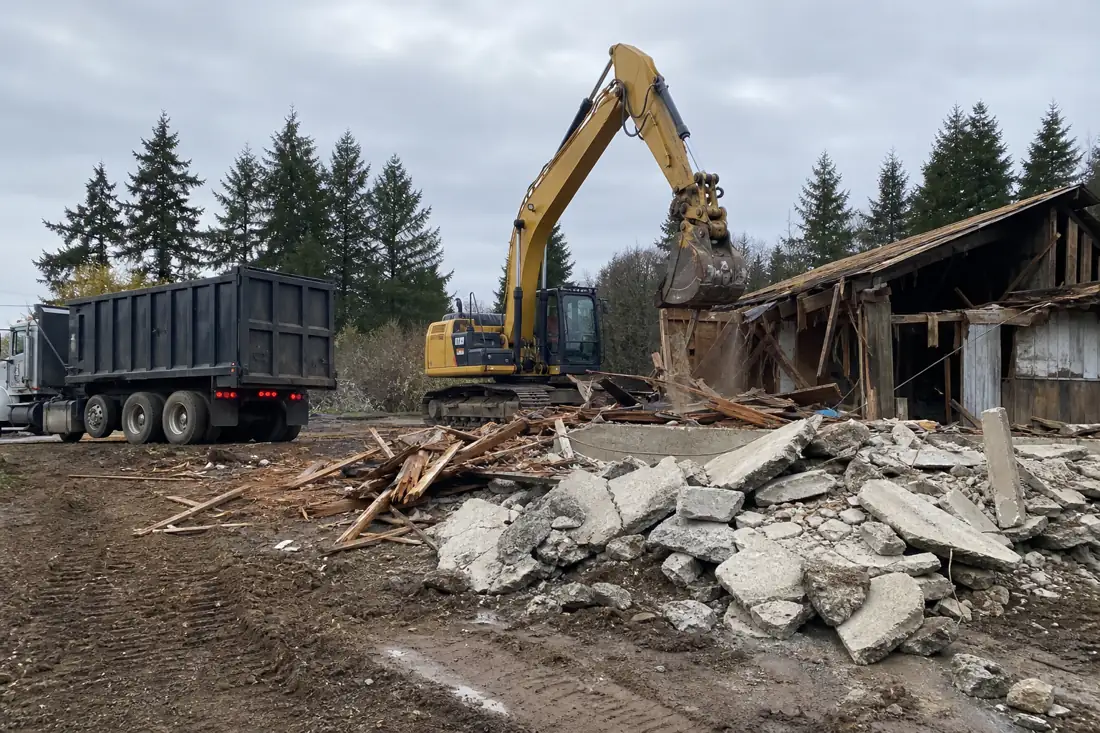
Demolition work underway on a hemmed-in residential lot in Cornelius, OR with neighbor structures visible nearby
Teardowns on tight Cornelius lots require barriers, access planning, and utility coordination before any equipment moves.

What a Tight-Lot Demolition Actually Involves

Demolition on a hemmed-in lot in Cornelius requires sequencing the job around constraints on all four sides rather than simply positioning the machine and starting. Access width, neighbor proximity, haul routing, and debris staging all have to be worked out before a bucket swings. Here is what that process covers in practice.

These logistics are factored into the project cost and schedule from the first site visit, not added as surprises after mobilization. Working with excavation contractors in Hillsboro, OR who already know Washington County’s permitting requirements keeps the administrative side of the job from adding unexpected weeks to a timeline that should be measured in days.

Why the Machine Decision Is Made at the Gate, Not the Catalog

On a wide rural site the equipment decision is straightforward: run the largest machine that completes the job fastest. On a Cornelius lot the logic reverses. You start from the access width—the gate opening, the driveway approach, the width of the gap between the house and the fence—and work backward to capability. A standard excavator with a twenty-foot reach may have a transport width that blocks the only opening into the yard. A compact machine that passes through the gate has a shorter reach and requires more repositioning to complete the same teardown. Neither option is wrong by itself; the constraint is the physical geometry of the site, and that geometry has to be measured before a price or a schedule is set. Quoting a job without walking the access is how contractors end up with a machine on a trailer that cannot get where it needs to go.

The Hole Left Behind Is the Second Half of the Job

Removing a structure in a dense area like Cornelius creates an open excavation that does not stay neutral. Loose soil settles unevenly over the following months. Surface water from rain or irrigation migrates toward the lowest point—which, on a tight lot, may be toward the adjacent foundation rather than away from it. An open pit next to a shared fence creates ongoing liability. The work that follows the teardown—backfilling with clean material, compacting in measured lifts, and grading so that surface drainage moves away from neighboring structures—is part of the same project scope, not a separate engagement to schedule later. Our Hillsboro excavation crews scope the backfill and compaction plan at the same time as the demo plan so the site is stable and graded when we leave, not left as a hazard for the next contractor to sort out.

Permits, Costs, and Scheduling in Cornelius

Demolition in Oregon requires a Washington County demolition permit plus written utility disconnect confirmations from every provider before mechanical work can legally begin. Permit processing time varies, but the disconnect coordination often takes longer—utility companies operate on their own dispatch schedules, and two to three weeks of lead time per provider is common. Starting that coordination at the same time as permit application keeps the schedule from slipping by a month before equipment arrives on site. Structures built before 1978 also require asbestos testing by a licensed inspector, and any confirmed asbestos-containing materials must be abated by a certified contractor before demolition begins. That abatement step is time-fixed; there is no way to compress it without cutting regulatory corners, and the cost of a work stoppage for an un-permitted demo far exceeds the permit fee.

On a hemmed-in Cornelius lot, hauling costs reflect the access constraints. Debris cannot be stockpiled in the street right-of-way, which means each load has to be sorted, staged within the property, and hauled directly. Mixed loads cost more to dispose of than pre-sorted material, so separation at the point of demolition saves money on the back end even though it takes more time on the front end. Silty clay soil also stays wet from October through May, and running loaded trucks across wet ground or a neighbor’s lawn in winter causes ruts and subsoil compaction that add repair costs to the project. The Hillsboro excavation crew plans haul routes, material staging, and dry-ground windows at the start so none of those costs appear as surprises at closeout.

Excavation Services We Provide in Cornelius

Serving Cornelius and all of Washington County, our team coordinates permits, utility disconnects, and neighbor protection on every project — reach the excavation contractors in Hillsboro, OR who know this area.

Drainage & French Drains

Drainage & French Drains →

Site Preparation

Site Preparation →

Utility Trenching

Utility Trenching →

Grading & Leveling

Grading & Leveling →

Frequently Asked Questions

How close to my neighbor's property can demolition equipment work in Cornelius?

Equipment can work right up to the property line where the structure requires it, but a planned buffer for debris catch and soil protection is set on the neighbor-facing sides before work begins. Temporary barriers contain falling material and prevent concrete or framing pieces from crossing the property line. On Cornelius lots where setbacks are minimal, that barrier setup is not optional — it is how adjacent property stays undamaged through the whole teardown process.

What if the only gate to my Cornelius lot is too narrow for a full-size excavator?

Narrow access is one of the first constraints evaluated on a tight lot. If the gate or driveway approach will not pass a standard machine, the options include a compact excavator that fits the opening but takes more passes, temporary removal of a fence panel to widen the access, or a different rigging approach from the street. Each option carries different time and cost implications. The right answer depends on the structure size, neighbor agreements, and haul logistics, not the machine catalog.

Do utilities need to be disconnected before demolition in Cornelius starts?

Yes, and written confirmation from each provider is required before any mechanical work begins. For a Cornelius residential demolition that means coordinating separately with the electric utility, gas company, water district, and any telecom or cable providers. Each has its own scheduling timeline, and some take one to two weeks to dispatch a technician. Starting the disconnect process at the same time as permit application is the way to keep those lead times from adding a month to the front end of the job.

Does the teardown leave a hole that needs to be filled and graded?

A full structure removal leaves the basement or crawl space excavation open, and that hole has to be addressed before the project is finished. Clean fill material is brought in, compacted in measured lifts to prevent future settlement, and the surface is graded so water drains away from adjacent structures rather than pooling at the lowest point on the lot. Skipping compaction produces visible ground settlement months later, which can crack surrounding hardscape or affect a neighboring foundation when lots are close together.

How much does demolition cost on a tight residential lot in Cornelius?

Cost depends on structure size, access width, material composition, haul distance, and whether asbestos testing or abatement is required. On a hemmed-in Cornelius lot, limited staging room and restricted haul routing add setup time compared to a wide-open site, and that time is part of the real price. Permits, utility disconnection coordination, and sorted debris hauling are separate line items that vary by project. An accurate number requires a site visit, not an estimate from a photo or square footage alone.

When is the best time of year to schedule demolition in Cornelius?

Summer and early fall offer the best ground conditions for a tight-lot teardown in Cornelius. Washington County silty clay stays wet from October through May, and running loaded haul trucks across wet ground or a soft access path causes ruts and compaction damage that cost real money to repair — especially when the route crosses a neighbor-adjacent strip of lawn. When a project must proceed in the wet season, the haul plan is designed around hard surfaces only rather than attempting to recover from ruts after the fact.

Get Your Free Hillsboro Excavation Estimate

Tell us about your project and we will come walk the site and give you a straight, itemized quote — no obligation, no pressure. Call us, or send the form and we will get back to you the same business day.

We only use your info to contact you about your project. No spam, ever.

Prefer to talk?

Call or text and reach us directly. We answer during business hours and return every message.

(971) 397-9361

Hours: Mon–Sat, 7am–6pm