Home › North Plains
A 0.90-square-mile city with acreage stretching well past it — and that is where most of the machine time goes.
North Plains is a small city with a large working footprint around it, and that gap is the single most useful thing to understand about excavation work here. The city itself covers just 0.90 square mile, all of it land, with a population of 3,441 at the 2020 census. The farmland, wooded parcels, and rural acreage surrounding it stretch far past the city limits — and that is where most of our machine time in the North Plains area is actually spent.
Hillsboro Excavation Co. is based a short run southeast, and North Plains sits right off U.S. 26 on the northwest outskirts of the Portland metropolitan area. Highway access matters more than mileage on this kind of job: it means we can move a machine, a truck, and rock to a North Plains site quickly, which is what keeps a rural job from becoming a mobilization-heavy job.
North Plains was platted in September 1910 by the Ruth Trust Company of Portland, which had bought up area tracts after James J. Hill planned to extend United Railways out this way. It stayed small for decades. When residents voted 90 to 56 to incorporate on June 25, 1963, the population was around 500. It stands at 3,441 today.
That growth pattern — a rail-speculation plat, a long quiet stretch, then real expansion — produces a specific mix of dirt work. There are properties here on infrastructure that predates modern standards by generations, sitting near newer construction built to current code, sometimes on the same street. We do not assume which one we are dealing with until we look.
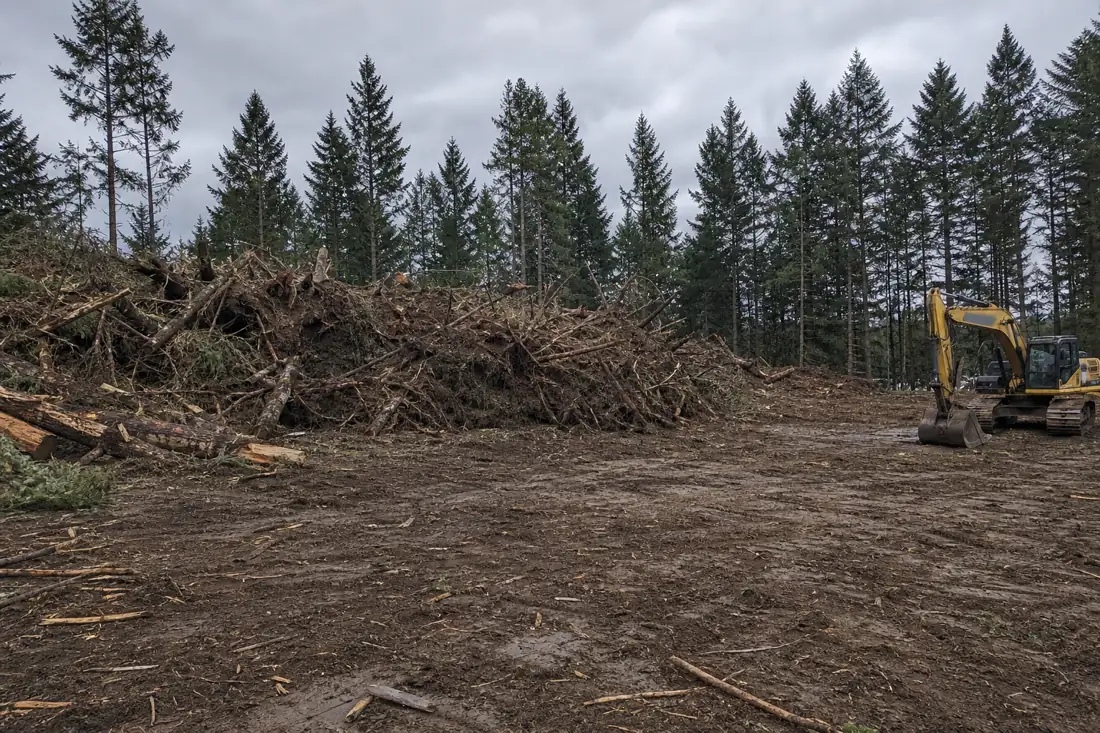
Outside the city limits the jobs change character: longer utility runs to outbuildings and shops, gravel driveways and access roads that have to survive a wet season of loaded trucks, drainage on sloping ground where water arrives from a neighboring property, and land clearing on parcels that have grown in for years. Access is usually easier than an in-town lot — there is room to work — but the water has farther to travel and more ground to cross before it leaves the site.
If you are not sure whether your project is a drainage job or a grading job — a very common question out here, because they often solve the same symptom — tell us what you are seeing and we will tell you which one it is. Full service detail is on our main Hillsboro excavation page.
North Plains was platted in 1910 and did not incorporate until 1963, when about 500 people lived here. Most of its growth to 3,441 came afterward. The result is a town where a property built to current code can sit directly beside one running on infrastructure that predates modern standards entirely — and from the street you often cannot tell which is which.
That matters before a machine starts. On the older properties, service lines tend to be shallower than the current standard, laid on routes that made sense to whoever dug them, and recorded loosely or not at all. On the newer ones, everything is where the drawings say. Treating the second like the first wastes time; treating the first like the second breaks something. We establish which we are working with by potholing where the record is thin, rather than assuming the paint marks tell the whole story.
The same split shows up in drainage. Newer construction was graded to shed water under current rules; older properties were graded to whatever standard applied at the time, and some were never really graded at all. A drainage complaint on an older North Plains property is frequently a grading problem that has been quietly worsening for decades, not a recent failure.
Season drives scheduling on every job our Hillsboro excavation crew runs out here. The North Plains area has a warm-summer Mediterranean climate: dry summers with no monthly average above about 71.9°F, but stretches that push past 100°F for several days most years. That heat is a genuine scheduling factor on dirt work, not small talk. Dry, hot ground compacts well and hauls clean, which makes summer the best window for driveways, pads, and anything requiring real compaction. It also means dust control on a rural site with a long gravel approach becomes part of doing the job properly.
The flip side is the wet season, when the same ground that compacted beautifully in August will not hold at all. We schedule compaction-critical work into the dry window whenever a project allows it, and we tell you when it does not.
Most North Plains jobs happen on the rural ground outside the city limits, which shapes this list toward clearing, access, and long runs. Follow any service through to our main Hillsboro page for full detail.
Rural acreage around North Plains makes clearing a different job from in-town work, so it has its own page. The rest of what our Hillsboro excavation crew does is here:
Acreage jobs frequently combine clearing with access and drainage. See the full excavation service list for how each is scoped.
All North Plains services · How we scope a job · Start from the homepage
That is where most of our North Plains-area work happens. The city itself is only 0.90 square mile, and the farmland and rural parcels around it extend well past that boundary. Land clearing, access roads, long utility runs, and acreage drainage are the bulk of what we do out there.
Quickly. North Plains sits right off U.S. 26, and we are based a short run southeast in Hillsboro. Highway access matters more than raw mileage for moving machines, trucks, and rock, and it is what keeps a rural job from turning into a mobilization-heavy one.
Yes, and the difference is entirely in the base. A gravel driveway that ruts out by January was almost always built by dumping rock on native soil without excavating and compacting a proper base underneath. On rural North Plains properties with loaded vehicles and long approaches, we dig out the soft material, build and compact the base in lifts, then surface it. Costs more up front, lasts years longer.
Summer. The area has a warm-summer Mediterranean climate with dry summers that regularly push past 100 degrees for a few days, and that dry ground compacts and hauls far better than winter mud. We schedule pads, driveways, and anything compaction-critical into the dry window whenever the project allows, and we say so plainly when it does not.
Often yes, and it is a common rural North Plains problem on gently sloping ground. The fix is usually intercepting the water before it reaches your structures and giving it a controlled route out, through some combination of regrading, a French drain, or a swale. We look at where the water actually comes from and where it can legally and practically go, then build to that.
Often, and which authority applies depends on whether you are inside the 0.90-square-mile city limits or on the acreage beyond them — a distinction that catches people out here constantly. County jurisdiction, septic and well setbacks, and Clean Water Services erosion-control rules all shift depending on which side of that line you sit. We confirm jurisdiction before quoting so the permit path is priced in from the start.
Tell us about your project and we will come walk the site and give you a straight, itemized quote — no obligation, no pressure. Call us, or send the form and we will get back to you the same business day.
Call or text and reach us directly. We answer during business hours and return every message.
(971) 397-9361Hours: Mon–Sat, 7am–6pm