Home › North Plains
Rural parcels off U.S. 26 need access roads engineered for loaded trucks and wet-season drainage — not a gravel apron sized for a passenger car.
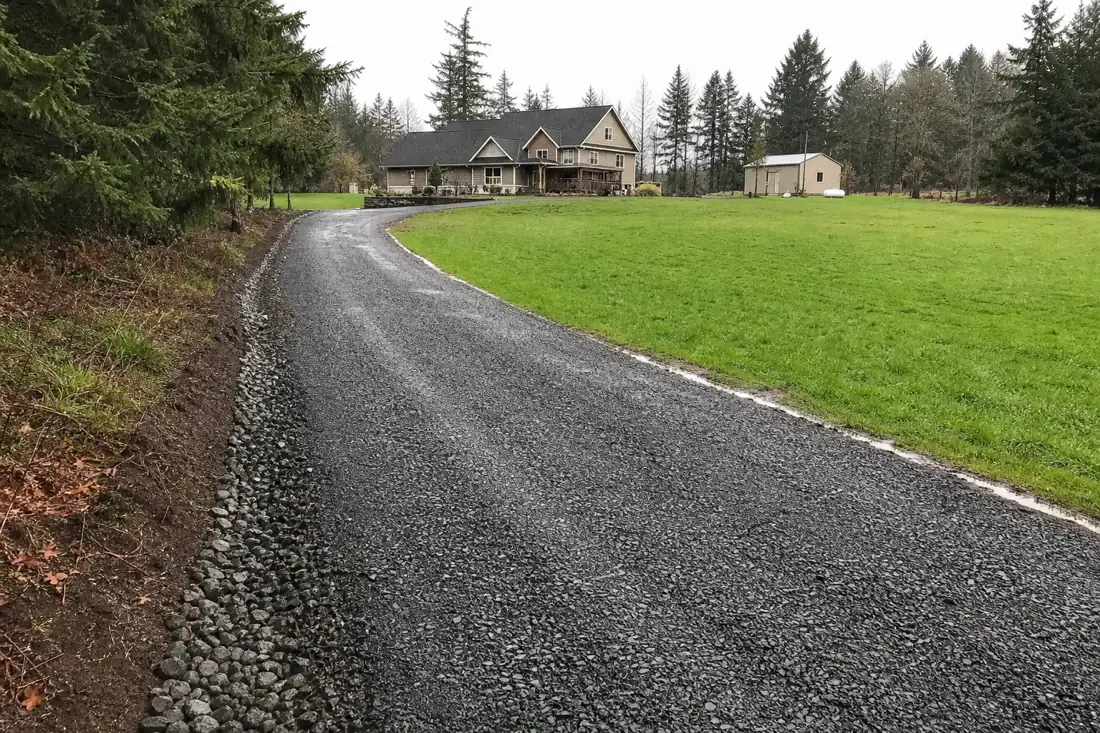
North Plains sits on 0.90 square miles of city land off U.S. 26, but the agricultural and wooded parcels surrounding it stretch for hundreds of acres. Driveways on those parcels are not 30-foot residential aprons — they are access roads, sometimes reaching several hundred feet from the county road to the building site. The work involved in building and maintaining a long rural access drive is fundamentally different from an in-town driveway job, and the economics are completely different too. Hillsboro Excavation Co. has built access roads on large parcels throughout the North Plains area, where the challenge is getting loaded equipment trucks, propane deliveries, and emergency vehicles through reliably regardless of season.
The parcels off U.S. 26 and the surrounding Washington County roads range from a few acres to several dozen. Many have no existing improved access, or a worn two-track that has never been properly graded or drained. When the Tualatin Valley’s October through May wet season arrives — and North Plains summers can push above 100°F for several days, followed by months of rain — an unimproved access road becomes impassable mud within weeks. Fixing it after the fact costs more than building it right the first time.
A long rural access road introduces engineering considerations that simply do not apply to a short urban driveway. Getting each of these right early determines whether the road holds up under real agricultural and delivery use for years.
These elements work together as a drainage system, not as separate checklist items. A culvert placed without matching ditch grade will back up and fail. Crown without ditching sheds water into the adjacent timber or crop ground rather than controlling it. The excavation contractors in Hillsboro, OR who understand long rural drives plan the water path first and then design the road around it.
An in-town residential driveway is designed for passenger vehicles: a Toyota Camry at roughly 3,500 pounds, maybe an occasional pickup at 5,000 pounds. An access road on a North Plains rural parcel has to carry propane tankers, septic pump trucks, farm equipment, construction material deliveries, and in many cases a loaded fire apparatus responding to a structure fire or brush incident. Those vehicles can weigh 30,000 to 80,000 pounds. The difference is not cosmetic. Base thickness, rock size, and compaction lift depth all change when the design load is an 80,000-pound tanker rather than a half-ton pickup. Sizing rock for passenger cars and then running heavy equipment over it will destroy the surface in one or two passes.
On a long access road, rock is typically placed in two or three lifts. A coarser base aggregate goes down first, compacted to a stable platform. A mid-grade layer follows to fill voids and bridge any remaining soft spots. A top course of angular crushed rock finishes the travel surface with material that interlocks under load rather than rolling loose. Each lift is compacted before the next goes down. Skipping lifts and dumping all material at once leaves a loose, uneven surface that ruts immediately under heavy equipment and sheds its top rock at every corner. The volume of material required for a several-hundred-foot access road is large enough that rock sizing and delivery sequencing become logistical decisions, not just material choices. Our Hillsboro excavation team coordinates rock type, crush size, and delivery schedule to keep lifts properly staged across the full length of the road.
The economics of a long rural access road are volume-driven. Mobilization is a smaller fraction of total project cost because it is spread over hundreds of feet of work and many tons of material. The biggest cost variables are total length, number of culverts or cross-drains required, whether the subgrade needs excavation and replacement or can simply be shaped and compacted, and rock type and sizing. An 811 underground utility locate is required before any grading or trenching begins, regardless of parcel location. Oregon DEQ’s 1200-C stormwater permit applies if the project disturbs an acre or more of ground, which a long rural driveway with ditching can easily reach.
Maintenance expectations on a long access road are different from an in-town driveway. Heavy truck traffic, especially in the Oct–May wet season, displaces top rock and erodes crown. Most rural access roads need regrading every two to four years depending on traffic volume and whether proper crown was established on the original build. Regrading is far less expensive than rebuilding a failed base, which is the outcome when the road is neglected until water has tracked down the centerline and washed out the lower rock layers. The Hillsboro excavation crew can assess whether an existing access road needs regrading only or requires a base rebuild before another season of heavy use.
North Plains landowners rely on excavation contractors in Hillsboro, OR who build rural access roads with the ditching, culverts, and lift-by-lift compaction that long drives require.
Length introduces drainage engineering that does not exist on a short in-town driveway. A long run has multiple low points where water collects, requiring culverts or cross-drains at each one. Roadside ditching has to run continuously to intercept flow before it saturates the base. Crown has to be maintained across the full distance, not just at the entrance. Turning radii for large vehicles have to be planned into the layout. Each of these is a separate failure point if skipped, and failures on a long road are more expensive to repair than failures on a short one.
At a minimum, a rural access road near North Plains should carry a loaded propane tanker or septic pump truck, which can run 30,000 to 50,000 pounds. If the parcel has a structure, fire apparatus access is a practical requirement: a loaded fire truck can reach 60,000 to 80,000 pounds. Designing only for passenger cars and then running heavy equipment over the road will destroy the surface in one or two passes. Base thickness, rock size, and compaction lift depth all scale upward with design load, and that calculation has to be made before the first rock is placed.
Washington County requires permits for grading work that alters drainage patterns, installs culverts in a roadside ditch, or creates a new approach to a public road. Oregon DEQ’s 1200-C stormwater permit applies if total ground disturbance reaches one acre or more — a realistic threshold for a long access road with ditching. An 811 underground utility locate is required before any excavation regardless of rural location. Clean Water Services erosion-control rules cover any bare-ground disturbance during the wet season.
The number depends entirely on the topography of the parcel. A culvert or cross-drain is needed at every low point where water collects across the road rather than running off to the side. On flat or gently rolling ground, that might be one or two. On irregular terrain with several drainage swales crossing the road alignment, it could be four or more. Each culvert has to be sized for the contributing watershed area and set at the correct grade so water enters cleanly on the uphill side and exits without eroding the downhill embankment.
Cost on a long rural access road is driven primarily by total volume of material, number of culverts, and whether the existing subgrade is stable or needs excavation and replacement. Unlike a short residential driveway, mobilization is a smaller fraction of the total because it is spread across hundreds of feet of work. The biggest variables are rock type and quantity, culvert count and pipe size, and ditching length. Projects that trigger Oregon DEQ’s 1200-C permit add engineering and compliance costs. A per-foot estimate is meaningful only after a site walk and subgrade assessment.
Most rural access roads in the North Plains area need regrading every two to four years, depending on traffic volume, vehicle weight, and how well crown was established on the original build. The Oct–May wet season accelerates erosion: heavy truck traffic on wet gravel displaces top rock quickly, and water that begins tracking down the centerline rather than shedding to the ditch will wash out lower base layers within a season. Regrading to restore crown before that happens costs a fraction of rebuilding a failed base.
Tell us about your project and we will come walk the site and give you a straight, itemized quote — no obligation, no pressure. Call us, or send the form and we will get back to you the same business day.
Call or text and reach us directly. We answer during business hours and return every message.
(971) 397-9361Hours: Mon–Sat, 7am–6pm