Home › Septic System Installation in Hillsboro, OR
Septic system installation in Hillsboro, OR — drainfield sizing, perc testing, tank placement, setbacks, and Washington County permits handled by a local excavation crew.
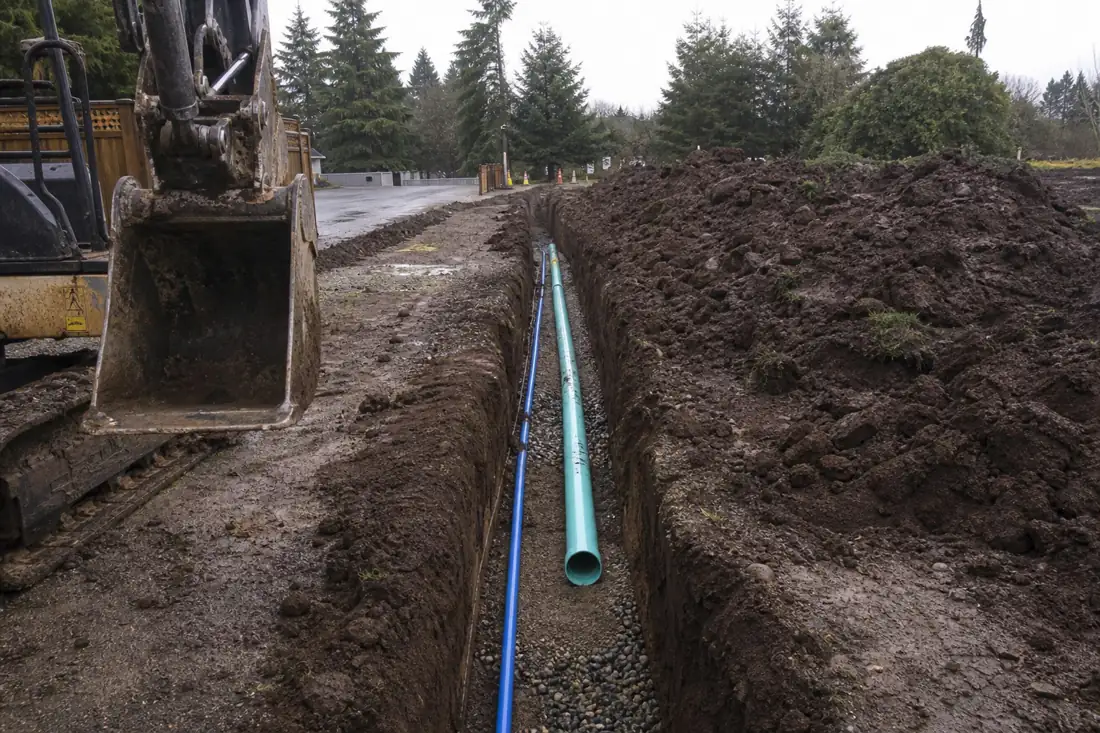
A septic system handles all the wastewater from a home or business that is not connected to a municipal sewer line. That means the tank, the distribution box, and the drainfield all have to be sized, placed, and permitted correctly before a single trench is cut. Hillsboro Excavation Co. manages the earthwork side of septic installations in Washington County — the excavation, backfill, and grading that make the system work and satisfy county inspection.
Washington County requires a site evaluation, a percolation test, and a soil profile log before the county will issue an onsite wastewater permit. The results determine how many linear feet of drainfield trench you need, how deep the gravel bed must be, and whether a standard gravity system is even feasible on the lot. Tualatin Valley silty clay dominates most of the county, and it changes what’s possible in ways that matter before any equipment is scheduled.
The visible part of a septic installation — the concrete or poly tank — is only one component. The drainfield that receives the effluent from that tank is where most of the earthwork happens and where most failures eventually show up.
Septic work on a lot with poor drainage or heavy clay requires extra planning at the design stage, not after excavation begins. Working with excavation contractors in Hillsboro, OR who have dug in Washington County soil means fewer surprises when the inspector arrives.
Silty clay does not drain. The native soil across much of Washington County has a percolation rate slow enough that standard-length trenches cannot move effluent fast enough to prevent surfacing. When a perc test returns a number slower than 60 minutes per inch, a conventional gravity drainfield may need to be replaced with a pressure-dosed system, a mound system, or a sand filter. Each of those alternatives requires more excavation, more imported fill, and a larger site footprint than the homeowner originally planned. Identifying this early saves the cost of a re-design after breaking ground.
Washington County’s wet season runs from October through May. During that window the water table across much of the Tualatin Valley sits within two to three feet of the surface. Drainfield trenches have to maintain vertical separation from the seasonal high water table, which is measured at the worst point of the year, not the day you dig. Our Hillsboro excavation crews schedule septic work around seasonal conditions and advise on whether a mid-winter start will leave the drainfield area too saturated to compact backfill properly. A trench backfilled in standing water will settle unevenly and can damage the distribution pipe under load.
Washington County Environmental Health issues onsite wastewater permits. The permit application requires a site plan drawn to scale showing the tank location, drainfield location, well location if applicable, and all required setbacks. Tanks must be at least 10 feet from any structure, 50 feet from a well or surface water, and 5 feet from a property line. Drainfield trenches carry their own setbacks that vary based on whether the boundary is a well, a water feature, a road, or a neighboring structure. The permit fee covers a minimum of two inspections: a rough-in before backfill and a final after the system is complete. Any deviation from the approved drawing during excavation requires a field change request before continuing.
Scheduling matters because the county books inspections at least two business days out. If the Hillsboro excavation crew finishes trenching on a Friday, the inspection may not happen until Wednesday, and backfill can’t start until after the inspector signs off. That hold time is billable if a crew has to sit on a job or if equipment has to be pulled and repositioned. Building the inspection window into the schedule before mobilizing prevents a four-day system from turning into a ten-day one.
Tank failure usually shows up as sewage backing up into the house or slow drains throughout the building. Drainfield failure shows up outside — wet spots, green stripes above the trench lines, or odor near the absorption area. The causes are different: tank problems are often solids buildup or a cracked baffle, while drainfield problems are usually biomat clogging the soil pores or a saturated water table that eliminates the drainage gradient entirely.
Washington County sizes drainfields based on bedroom count and perc rate, not square footage of the house. A three-bedroom home in soil with a perc rate of 30 minutes per inch typically requires around 400 to 500 linear feet of trench. Slower soil means more trench. The exact number comes from the soil evaluation report, not a rule of thumb, so there is no universal answer until the test is done.
Washington County requires an onsite wastewater permit and a licensed plumber or registered installer for the tank and pipe connections. The earthwork itself can be done by a licensed excavation contractor, but the permit must be pulled before any ground is disturbed. A homeowner who starts without a permit faces stop-work orders, possible fines, and the cost of exposing covered work for a belated inspection.
A properly designed and installed drainfield in Washington County silty clay soil can last 25 to 40 years if the tank is pumped on schedule and no non-biodegradable materials enter the system. Clay soils develop biomat faster than sandy soils because the absorption rate is slower, so the drainfield runs closer to capacity continuously. Resting a failed field while a second field absorbs load is one option; full replacement is another.
A conventional gravity septic system on a site with adequate perc rates typically runs $15,000 to $30,000 in Washington County, covering excavation, tank, distribution materials, and backfill. Lots with slow perc, high water tables, or limited setback clearances can push the cost significantly higher if a mound or pressure-dosed system is required. The soil evaluation result is the single biggest variable — it is worth getting that report before budgeting for anything else.
Yes. Replacing a tank in Washington County requires a permit from Environmental Health even if the drainfield is not being touched. The permit covers inspection of the new tank, the inlet and outlet connections, and the condition of the distribution box. If the inspector finds the existing drainfield is failing, the repair scope expands. Replacing a tank without a permit can void any future sale inspection and create liability when the property transfers.
Tell us about your project and we will come walk the site and give you a straight, itemized quote — no obligation, no pressure. Call us, or send the form and we will get back to you the same business day.
Call or text and reach us directly. We answer during business hours and return every message.
(971) 397-9361Hours: Mon–Sat, 7am–6pm