Serving Hillsboro & all of Washington County, OR Free estimates: (971) 397-9361
Hillsboro Excavation Co. Get a Free Quote

Home › Stump Removal in Hillsboro, OR

Stump Removal in Hillsboro, OR

Stump removal in Hillsboro, OR — grinding vs. full extraction, root ball backfill and compaction, and disposal of grindings by a Washington County excavation crew.

Licensed & insured in Oregon Free on-site estimates Local Washington County crew Wet-season ready

A cut stump left in the ground is not simply cosmetic. The root system beneath it can span two to three times the diameter of the trunk, and that entire mass either needs to be ground below grade or fully extracted before the site is usable for building, grading, or utility installation. Hillsboro Excavation Co. handles stump removal as part of larger land clearing scopes and as standalone work when a single tree has been felled and needs to come out before a project can continue.

The two methods — grinding and full extraction — leave the site in fundamentally different conditions. Which one is appropriate depends on what comes next: lawn restoration, a foundation, a utility trench, or a driveway. Choosing the wrong method for the intended follow-on work costs time and money to correct later.

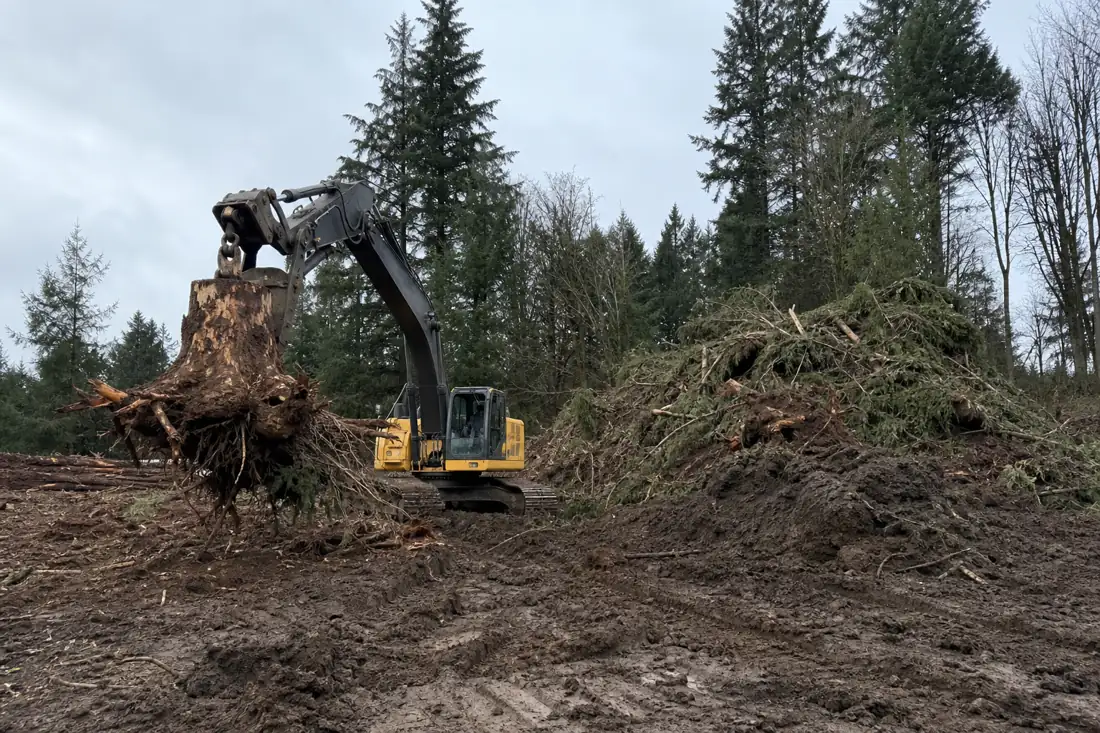
Land clearing and stump removal in Hillsboro Oregon
Large stumps in Washington County clay often have root masses extending well beyond the visible canopy drip line.

Grinding vs. Full Extraction: What Each Method Leaves Behind

Both methods remove the visible stump, but what remains in the soil is completely different. That difference determines whether the finished site can support a structure, carry surface loads, or be planted without future settlement problems.

Matching the removal method to the site plan prevents having to re-excavate. Projects that involve any kind of structure, pavement, or buried utility benefit from working with excavation contractors in Hillsboro, OR who evaluate the whole site scope before deciding which approach to use.

Root Ball Size and Why It Surprises Property Owners

Most property owners estimate root spread based on what the tree canopy looked like. That estimate is almost always too small. A Douglas fir or big-leaf maple common in Washington County can have lateral roots extending 1.5 to 2 times the tree’s height outward in every direction, and in silty clay soil roots often concentrate in the upper 18 inches where air and drainage are better. The visible stump might be 24 inches in diameter, but the root ball being pulled can weigh several tons and span 12 feet across. Equipment that is undersized for the actual root mass will either fail to extract cleanly or damage the surrounding area trying to get leverage.

The Settlement Problem When Roots Decay in Place

When a stump is ground below grade and the root system is left to decay naturally, the timeline for that decay is 10 to 20 years for a mature hardwood. As the roots break down they leave channels of loose material that compress under load. A driveway paved over an area with unextracted roots will show cracking and depression within a few seasons. A shed foundation poured over the same area will tilt as one corner settles faster than the others. Our Hillsboro excavation crews assess root depth and spread before recommending a method so the finished grade is actually stable, not just level at the time of completion.

Scheduling and Site Conditions for Stump Removal

Stump removal in Washington County is feasible year-round, but site conditions affect which equipment can access the area. After October, ground saturation from the wet season makes heavy equipment tracking a significant risk on lawns and soft soils. A grinder can often access a site when an excavator cannot because of its lower ground pressure per square inch. When full extraction is required in wet conditions, access mats or a different staging plan may be needed to avoid tearing up the yard around the stump. The root ball void also fills with water during wet months, which means backfill and compaction have to wait for conditions that allow proper moisture content in the fill material.

Stump count affects cost more directly than most other earthwork jobs. A single stump pulled by the Hillsboro excavation crew carries a minimum mobilization cost that makes the per-stump price look high compared to a ten-stump clearing job where the equipment is already on site. For larger land clearing projects, rolling stump removal into the clearing scope is almost always more cost-effective than scheduling it as a separate return visit. Grindings from grinding jobs can typically be spread on the property to avoid a separate haul-off cost, which changes the price comparison between the two methods.

Frequently Asked Questions

When should I choose grinding over full extraction?

Grinding is appropriate when the area will be returned to lawn or landscaping and no structure, pavement, or buried utility will cross the root zone. It is faster and cheaper than full extraction, and the root system left behind does not matter for light surface use. If you are planning a foundation, a concrete driveway, or a utility trench through that area, full extraction is the right choice because grinding leaves the root mass in place where it will eventually decay and settle.

How big is the hole after a stump is fully extracted?

The excavation pit from a full stump pull is typically 3 to 5 times the diameter of the trunk and can be 4 to 6 feet deep depending on tap root depth. For a 24-inch diameter trunk, expect a hole 8 to 10 feet across. That volume has to be filled with clean compactable material and compacted in lifts. Using the excavated native soil as backfill is possible if it compacts well; in Washington County clay it often needs to be amended or replaced with a gravel base for structural applications.

Can I use stump grindings as fill or mulch?

Stump grindings work as mulch in landscaped beds where you want moisture retention and weed suppression. They should not be used as structural fill anywhere load will be applied — they compress and decompose over time, causing settlement. Do not mix grindings into topsoil where you plan to establish lawn; the carbon-to-nitrogen ratio inhibits grass germination until the wood material breaks down, which can take two or more growing seasons.

Will a ground stump block a utility trench?

Yes, if the utility line crosses the stump footprint. The stump grinder only removes material to 8 to 12 inches below original grade, and lateral roots extend well beyond that area. A utility trench at 18 to 30 inches depth going through the root zone will hit lateral roots that require cutting. Hand digging through roots is slow and expensive compared to working in clear soil. If a utility run is planned anywhere near a stump location, full extraction before trenching saves time.

What does stump removal cost in Hillsboro?

Grinding a single stump typically costs $200 to $500 depending on diameter, with a minimum mobilization charge that applies regardless of stump count. Full extraction by excavator starts higher because it requires larger equipment and produces a pit that must be backfilled and compacted separately. Multiple stumps on the same visit reduce the effective per-stump cost significantly because the mobilization is shared. Getting an accurate number requires knowing stump diameter, depth of root system, and what the finished site will be used for.

Does the Oct-May wet season affect stump removal timing?

Grinding can proceed in wet conditions because the equipment footprint is small. Full excavation in saturated soil is more complicated: the pit fills with water, compaction of backfill is difficult until the moisture content of the fill drops to an acceptable range, and heavy equipment can cause significant turf damage on soft ground. Scheduling full extractions before October or after conditions dry in late spring avoids most of those complications on sites where lawn or surface finish matters.
Get Your Free Hillsboro Excavation Estimate

Tell us about your project and we will come walk the site and give you a straight, itemized quote — no obligation, no pressure. Call us, or send the form and we will get back to you the same business day.

We only use your info to contact you about your project. No spam, ever.

Prefer to talk?

Call or text and reach us directly. We answer during business hours and return every message.

(971) 397-9361

Hours: Mon–Sat, 7am–6pm