Home › Forest Grove
Forest Grove was platted in 1850, and the stumps left by trees that old often require excavation rather than grinding—root ball volume and what surrounds it make the call.
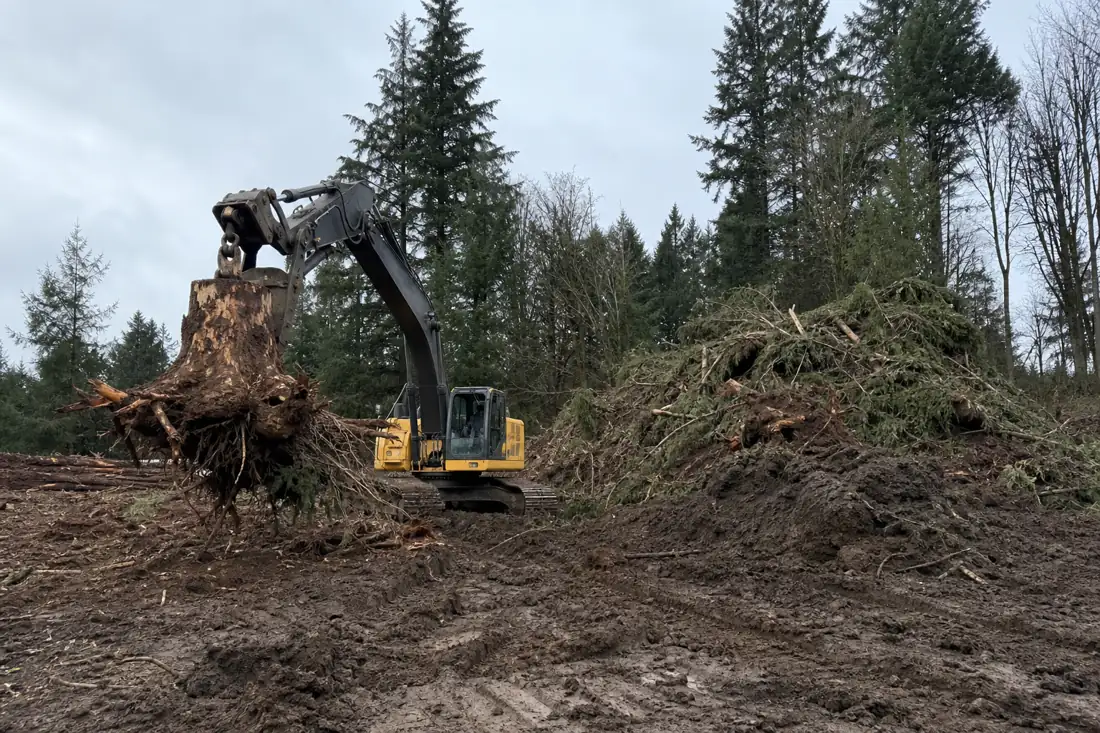
Forest Grove was platted in 1850, and the trees that have been growing on those original lots since then are not small. A stump removal in Forest Grove often means dealing with root systems that have had 50 to 100 years to expand beneath lawns, hardscape, and utility lines—legacy infrastructure that predates modern utility mapping and landscaping installed decades ago that cannot simply be dug up and relaid. Hillsboro Excavation Co. handles stump removal in Forest Grove by assessing root ball size and root spread before choosing a method, because on a property this old, those two numbers determine whether the job is a grinding job or a full excavation job, and that distinction affects everything from equipment selection to site restoration planning.
The distinction between grinding and excavation is not a preference; it is an engineering decision driven by root ball volume and what surrounds it. A stump grinder is efficient for stumps where the root mass is manageable and the surrounding area can absorb the volume of chips produced. A very large root ball—the kind left by a tree that has been growing since before Washington County was organized—can extend 10 feet or more in every direction and sit well below the depth a grinder can reach. Forest Grove, 25 miles west of Portland, was settled by Alvin T. and Abigail Smith, who arrived via the Oregon Trail in 1841. Properties here have trees corresponding to that history. When the root ball is structural enough that leaving it to decay in Tualatin Valley silty clay would eventually create a soil void beneath a patio or driveway, pulling the mass out now is the more straightforward answer than grinding to 8 inches and returning years later to correct subsidence.
On an older Forest Grove property, stump removal is a site-specific assessment before it is an operation. The age of the tree changes the size of the root mass; the age of the property raises the probability that hardscape, utilities, or valued plantings sit within the root spread; and the age of the service infrastructure changes what the 811 locate might and might not capture about what lies beneath.
Managing a Forest Grove removal correctly requires more pre-work than a newer-subdivision job, and that pre-work is what prevents damage to things that cannot be fixed afterward. The same site-assessment discipline applies across every established-property removal the excavation contractors in Hillsboro, OR run across Washington County.
A stump grinder removes what it can physically reach: the above-grade wood and the root mass to whatever depth the machine is configured to cut, typically 6 to 10 inches below grade on a standard residential run. That is sufficient for most stumps. It is not sufficient for a tree that has been growing since before the Oregon Territory became a state. A large root ball left to decay in silty clay goes through a 10-to-20-year breakdown process during which organic material compresses and disappears, creating a slow-motion void that the surrounding soil settles into. Under a patio, walk, or driveway, that void causes settlement that is expensive to correct after the fact. When the root ball is large enough and the surrounding hardscape old enough that it will crack and settle before the roots finish decaying, excavation that removes the mass now is less expensive in the long run than patching hardscape repeatedly for the next decade. Forest Grove’s historical character means the trees are often old enough and the hardscape often close enough that this calculation comes up regularly.
Forest Grove’s streets and utility corridors have been built and extended since 1850, and some service runs in the older sections of the city predate the records that a standard 811 locate returns. An 811 call is required by Oregon law and gives the crew the best available information about known utility positions. On a property where the tree predates the current utility map, a clean locate does not mean the root zone is clear of all buried infrastructure—it means that no currently mapped utility conflicts with the root zone. The Hillsboro excavation team treats a clean locate on an old Forest Grove property as a reason to proceed carefully rather than a reason to proceed fast. Hand-exposing soil around the root perimeter before deep excavation or extended grinding begins is the standard precaution when root spread runs further than what the locate precisely flagged, and when the property history gives reason to expect infrastructure that no longer appears on any current map.
Forest Grove stump removal pricing is shaped by factors that rarely appear in a standard residential quote: root ball volume and proximity to irreplaceable landscaping. A standard stump in a newer development yard has a predictable root mass that a grinder handles in a fixed amount of time. A mature tree on a Forest Grove property may have a root spread of 10 to 15 feet and a structural mass that requires multiple machine passes or full extraction with an excavator. The landscaping immediately around that stump—hedges, perennial beds, and established shrubs installed by owners over decades—cannot be carelessly disturbed, which constrains where the machine can operate and where excavated material can be staged. These site-specific constraints add time that a flat per-stump rate quoted without a visit cannot reflect.
Scheduling in Forest Grove also carries a wet-season consideration particular to large root-ball extractions. Washington County receives most of its rainfall between October and May, and the Tualatin Valley’s high winter water table raises soil moisture substantially by November. A large excavation to remove a mature root ball on a saturated lot disturbs a substantial surface area and can leave the yard in poor condition if spoil management is not planned from the start. The Hillsboro excavation crew schedules large extractions with drainage and site restoration built into the plan, stages material on run boards and tarps to protect established lawn and planted areas, and hauls the root mass and excavated soil off site so the yard is left in usable condition rather than requiring additional cleanup work that neither party anticipated at the time of the original estimate.
Stump removal is often the first step on a larger project—view the grading, drainage, and land-clearing services offered by excavation contractors in Hillsboro, OR.
Root ball size and what surrounds it are the deciding factors. A stump grinder reaches 6 to 10 inches below grade and handles most residential stumps adequately. But a mature tree on a property platted in 1850 may have a root mass extending 10 feet or more from the trunk, sitting beneath patio slabs or walks. Leaving that structural mass to decay creates a soil void that causes surface settlement over years. When the root ball is large and the nearby hardscape is old, removing the mass now costs less than correcting settlement later.
Potentially, depending on root position relative to the slab. Lateral roots that grew beneath existing concrete before the stump was removed continue to decay after the stump is gone. As that organic material breaks down in the Tualatin Valley’s silty clay over years, it creates voids that the concrete settles into. If the concrete is already cracked or lifted, the root is already affecting the slab. The crew surveys hardscape condition before work begins to document existing damage and identify where root cutting may be needed alongside the main stump removal.
811 captures what member utilities have mapped in the current record system. For a Forest Grove property with service runs that predate modern utility mapping, a clean locate gives you the best available information rather than a comprehensive guarantee. The crew treats a clean locate on an older property as a reason to proceed carefully and hand-expose soil around the root perimeter before deep excavation begins—particularly when root spread extends further than what the locate precisely flagged.
By planning the machine path and spoil placement before the machine enters the work area. Mature shrubs, hedges, and perennial beds on a Forest Grove property cannot be treated as temporary obstacles—some have been in place for decades and cannot be replaced at any reasonable cost. The crew identifies what cannot be disturbed, routes equipment to avoid those areas, and stages material on run boards or tarps rather than on planted beds. Where the root mass runs beneath a valued planting, the approach is to cut the root at the boundary rather than excavate through the planting itself.
Root ball volume and landscaping constraints around the stump are the two factors that separate Forest Grove pricing from a standard suburban estimate. A mature tree produces a root mass that may require multiple grinder passes or full excavation, and established plantings around it constrain where equipment can work and where material can be staged. These factors add time that a flat per-stump rate does not cover. A phone quote without seeing the root spread and surrounding conditions is an estimate that will change once the machine arrives; a site visit produces a number that holds.
Stump removal alone does not require a permit in Washington County jurisdiction. If the removal is part of a larger project disturbing an acre or more, Oregon DEQ’s 1200-C stormwater permit and Clean Water Services erosion-control requirements apply. For a standard residential stump removal in Forest Grove, the 811 locate before digging is the primary regulatory requirement. If the removal is followed by regrading, new drainage, or hardscape replacement, those follow-on activities may carry their own permit requirements depending on scope and site conditions.
Tell us about your project and we will come walk the site and give you a straight, itemized quote — no obligation, no pressure. Call us, or send the form and we will get back to you the same business day.
Call or text and reach us directly. We answer during business hours and return every message.
(971) 397-9361Hours: Mon–Sat, 7am–6pm