Home › Sewer Line Replacement in Hillsboro, OR
Sewer line replacement in Hillsboro, OR. Hillsboro Excavation Co. diagnoses failed laterals by camera, then replaces by open-cut or pipe-bursting. Licensed, insured, permit-ready.
When a sewer lateral fails in Hillsboro, the root cause is almost never a mystery — it’s root intrusion, pipe deterioration, or a sag that holds standing water until the line backs up completely. Hillsboro Excavation Co. handles sewer lateral replacement from the first camera run through trench backfill and surface restoration. This is not new-line installation; it is the targeted replacement of a pipe that has already failed or is close to failing, and the diagnosis step changes everything about how the work is planned.
Washington County’s older residential neighborhoods still have a significant share of clay tile and cast-iron laterals installed before PVC became standard in the 1970s. Both materials fail in predictable ways in the Tualatin Valley’s silty clay soils. Clay tile cracks at the bell joints as ground moisture cycles between the dry summer and the saturated October-through-May wet season, and tree roots probe every joint gap. Cast-iron corrodes from the inside as hydrogen sulfide gas attacks the pipe wall, producing a rough interior surface that snags solids and eventually leads to pinholes that allow groundwater infiltration. In a high winter water table area like Washington County, that infiltration adds volume the line was never designed to carry.
Replacement is a multi-step process that starts with understanding the failure mode before any excavation begins. Skipping the diagnosis step wastes money and sometimes misses the actual problem location, leading to a partial fix that fails again within a season.
Each step in this sequence depends on the one before it. Choosing between open-cut and pipe-bursting is a decision made after reviewing camera footage, not before, and the excavation contractors in Hillsboro, OR who do this work regularly know that the footage usually makes the method obvious.
The dominant failure mode in Washington County is root intrusion, not pipe age alone. Douglas fir, big-leaf maple, and ornamental cherry trees common in older Hillsboro neighborhoods have root systems that extend well beyond the drip line and seek out moisture throughout the warm growing season. A clay tile joint offset by even ⅛ inch is enough for a fine root tip to enter the pipe, grow, and eventually fill it. The root mass doesn’t just block flow — it holds paper and solids, accelerating a complete obstruction that cannot be cleared by jetting alone once the root ball is mature. The practical consequence is that a line showing roots on camera typically needs replacement rather than repeated cleaning, because jetting cuts roots at the entry point but leaves the pipe open for regrowth within the same season. Cast-iron lines fail differently but are equally common: the interior corrosion produces a rough surface, and once pinholes open, high-water-table groundwater enters and overwhelms lateral capacity during storms.
A replacement line that is set without a consistent fall to the main will re-clog even if the new pipe is perfect. A sag — a low point anywhere in the run — causes solids to drop out of suspension and accumulate. Over months this builds a partial blockage, then a complete one. The sag is often caused by improper bedding that allows the pipe to settle, or by an existing dip in the trench bottom that wasn’t corrected before laying pipe. Verifying continuous fall requires laser level checks at every joint during installation, not just at the end points. This is one reason camera inspection after backfill is required before the permit is closed: an inspector can confirm the pipe is in place and the slope reads correctly before the trench is sealed. Our Hillsboro excavation team sets pipe to grade during installation and does not rely on a single endpoint measurement to confirm slope across a 40- or 60-foot run.
A sewer lateral replacement in Hillsboro requires a City of Hillsboro plumbing permit and, if work crosses a public right-of-way, a separate street-cut permit. The trench must remain open for inspection before backfill, which is not a step that can be skipped or done retroactively. Permit and inspection fees are additional to excavation costs. For a typical single-family residential lateral of 30 to 60 feet, open-cut replacement costs more than a drain cleaning service but substantially less than rerouting through finished living space. Pipe-bursting on a comparable run can cost less than open-cut because surface restoration is minimal, but mobilization cost is fixed regardless of run length, so the savings narrow on shorter laterals. Material, depth, access, and restoration scope all move the number. Call 811 is required before any excavation — Washington County’s utility-locate rules apply countywide regardless of the urgency of the work.
The emergency-versus-planned distinction changes how quickly work can start. A lateral that is actively backing sewage into the house is an emergency: Washington County has provisions for emergency permits that allow work to begin the same day, with paperwork filed immediately after. A camera inspection that reveals significant root infiltration before the line backs up is a planned replacement — this scenario gives the property owner time to compare open-cut versus trenchless costs, schedule during dry weather when open-cut is faster and restoration is more straightforward, and coordinate the city main tie-in inspection. The Hillsboro excavation crew recommends getting a camera inspection at the first sign of recurring slow drain, because identifying root intrusion early almost always costs less than responding to an emergency backup that damages flooring, framing, or personal property.
A camera inspection gives a definitive answer. If the camera shows root balls filling the pipe, pipe wall corrosion, joint offsets, or a visible sag, cleaning buys time at best and the line needs replacement. If the camera shows an intact pipe with light root strands or grease buildup, jetting can restore flow. Repeat backups within the same year strongly suggest replacement is the right call rather than another cleaning.
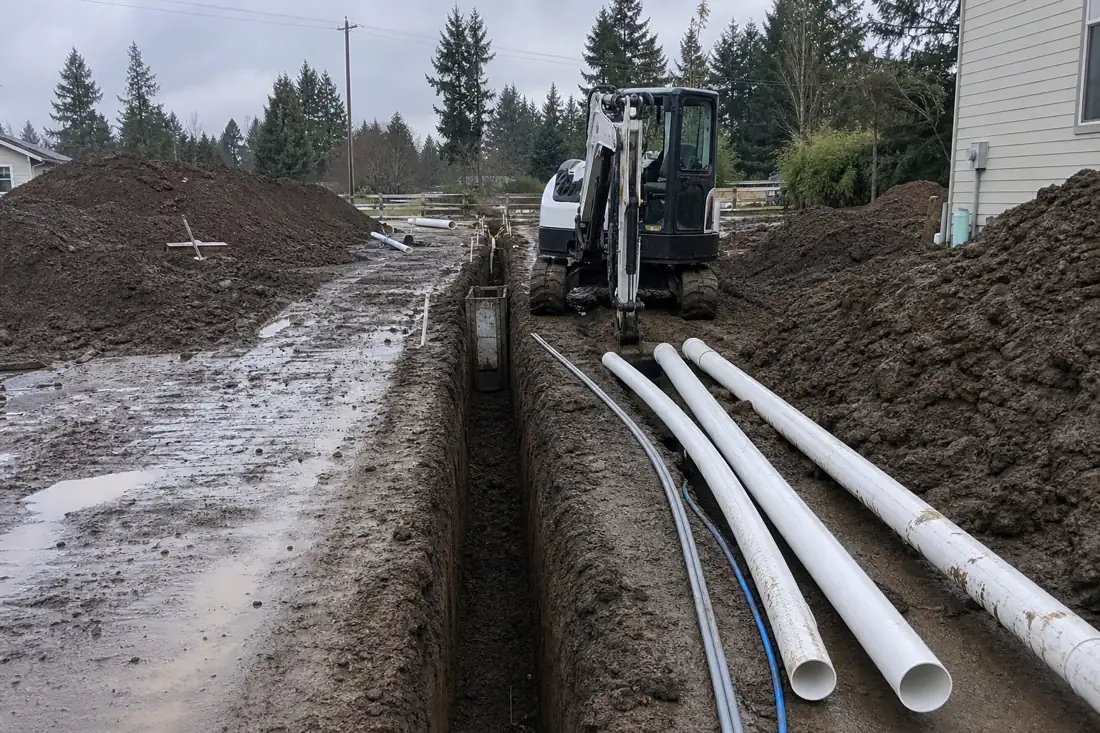
Open-cut excavates a trench along the full failed run, removes the old pipe, and installs new PVC bedded to a consistent grade. Pipe-bursting pulls a hydraulic head through the existing pipe, shattering it outward while pulling HDPE pipe behind it. Open-cut works on any pipe condition but requires surface restoration. Pipe-bursting avoids most surface work but requires the old pipe to be continuous enough to guide the equipment and structurally sound enough not to collapse the bore path.
In Hillsboro and throughout Washington County, the property owner is responsible for the entire lateral from the house foundation to the tap at the city main. The city owns the main sewer line in the street and the physical tap fitting. This means the cost of replacing a failed lateral is the property owner's obligation, not the city's, even if the failure point is near the property line. Confirming the exact tap location before work starts avoids disputes about scope.
Yes. The City of Hillsboro requires a plumbing permit for sewer lateral replacement. If the work crosses a public right-of-way or public street, a separate street-cut permit is also required. An inspector must observe the open trench before backfill to confirm pipe slope, joint quality, and bedding. Work that is backfilled before inspection fails and may have to be excavated again. Emergency work can begin under an emergency permit, with formal paperwork submitted promptly after.
Cost depends on run length, depth, method, and surface restoration scope. A 40-foot lateral at moderate depth using open-cut replacement including compacted backfill and lawn restoration runs in a different range than a 60-foot pipe-bursting job that avoids driveway cutting. Depth matters because deeper pipe means more soil to move per foot. The camera inspection cost is separate but typically applied toward the job total. Get an estimate after the camera run, not before, because the footage defines the actual scope.
Yes, but with added complexity. Washington County's October-through-May wet season means the trench may encounter the high winter water table, requiring dewatering to properly bed the pipe. Soft soil conditions slow excavation and compaction. Surface restoration seeding or sod must account for Clean Water Services erosion-control requirements, which stay in place until vegetation is established. Winter emergency work proceeds regardless of weather, but planned replacements scheduled in summer or early fall are typically faster and less costly to restore.
Tell us about your project and we will come walk the site and give you a straight, itemized quote — no obligation, no pressure. Call us, or send the form and we will get back to you the same business day.
Call or text and reach us directly. We answer during business hours and return every message.
(971) 397-9361Hours: Mon–Sat, 7am–6pm