Serving Hillsboro & all of Washington County, OR Free estimates: (971) 397-9361
Hillsboro Excavation Co.

Home › North Plains

Stump Removal in North Plains, OR

Agricultural and wooded parcels around North Plains generate stump fields after clearing — volume work priced by the site, not per unit.

Licensed & insured in Oregon Free on-site estimates Local Washington County crew Wet-season ready

When land is cleared around North Plains for farming, grazing, or development, the stumps that remain are rarely a one-off removal — they are counted by the acre. Hillsboro Excavation Co. handles this as volume work: pricing by cubic yard or by the site rather than per stump, because that’s the only math that makes sense when a clearing job leaves fifty or a hundred root masses spread across several acres. The goal is ground that can be farmed, mowed, or built on without sunken pockets forming wherever a root system once sat.

North Plains sits at the edge of the Portland metro on U.S. 26, and the parcels surrounding its 0.90-square-mile city limits are largely agricultural and wooded. Tualatin Valley silty clay holds moisture from October through May, which means stump root systems can be saturated and heavier than they appear above grade. That wet ground also compresses under equipment, so the timing of stump extraction work matters as much as the method. Misjudging soil conditions during the wet season can leave ruts and compacted lanes across a field that require a separate grading pass to repair before the land is usable again.

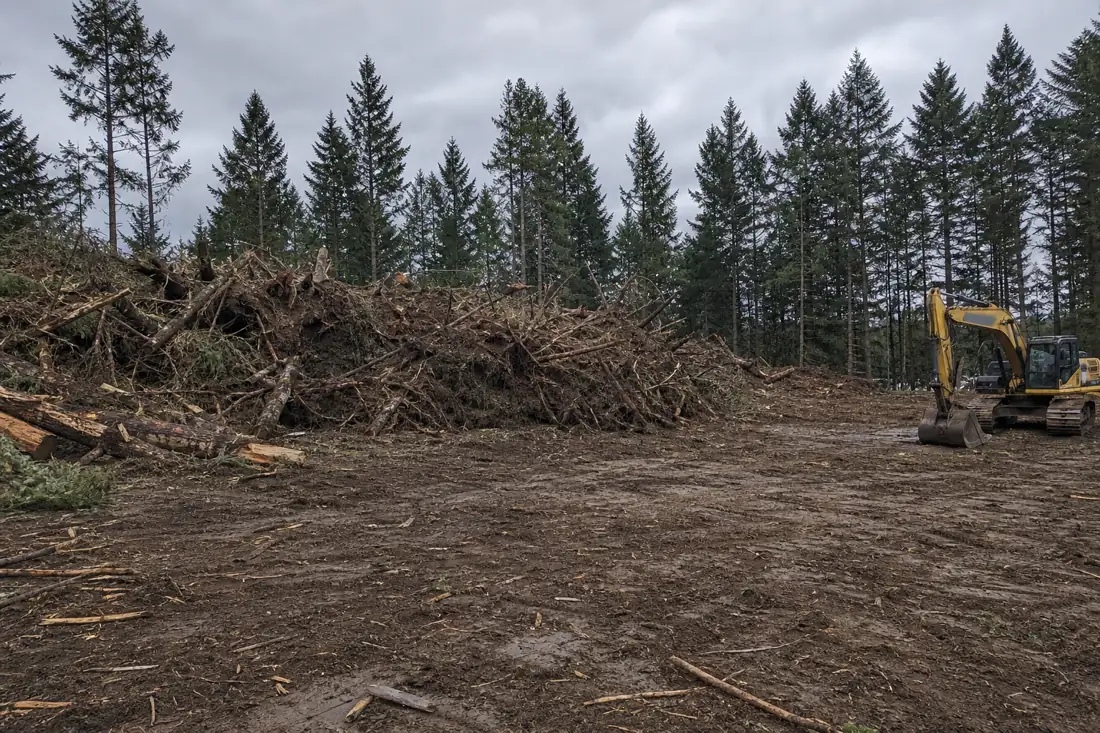
Cleared agricultural lot near North Plains OR after volume stump removal on acreage
A cleared parcel ready for farming or construction after full stump extraction, void backfill, and compaction across the site.

What Volume Stump Removal Involves

Acreage stump work differs from a single-tree removal in scope, sequencing, and what the ground needs to look like when the crew leaves. Each step below applies across every extraction point on the site rather than just once.

Those steps require the same heavy equipment and site planning involved in full land clearing, which is why volume stump work is quoted and managed like a site development job by excavation contractors in Hillsboro, OR who work the region regularly.

Underground Hazards That Change the Approach

On an agricultural parcel that has been farmed or irrigated for decades, the subsurface picture is rarely what a standard utility locate will show. Oregon’s 811 service marks only active public utilities — it says nothing about private irrigation laterals, subsurface drainage tile, or older systems installed before records were kept. Root zones on mature timber run six to twelve feet out from the trunk, and a large root in silty clay will often follow a buried drain tile line because that pipe is a reliable water source year-round. Pulling that root without knowing the tile is there can collapse or displace drainage infrastructure that the surrounding field depends on to stay workable in wet months. A field that loses its drainage can sit waterlogged for months before the damage is identified and repaired.

Grinding to Grade vs. Full Extraction — Which One the Ground Needs

When the site will be farmed or built on, full extraction is typically required because a stump ground to grade leaves the root system in place, and as those roots decompose over three to seven years, the soil above them collapses in unpredictable patterns. That settlement is not acceptable on a field that will carry equipment or on a pad that will carry a structure. Grinding to depth is a faster, lower-cost option when the site will be landscaped or left in pasture and minor settling can be tolerated, but it still leaves organic material underground that will change the soil profile as it breaks down. Our Hillsboro excavation crews assess the intended end use before recommending the method, because choosing wrong costs more to correct than the difference in the original price.

Pricing and Scheduling Volume Stump Work Near North Plains

Volume stump removal on acreage around North Plains is quoted on a site-visit basis rather than by a published per-stump rate, because the variables all shift the cost significantly: stump diameter, species, root spread, soil saturation at time of work, distance from equipment access, how many voids require fill material, and whether that fill has to be hauled in from outside the site. A field of fifty small-diameter alders after a clearing job prices differently than twenty large Douglas fir stumps whose root systems have bonded with adjacent material over decades. Backfilling and compacting multiple extraction voids adds a further line item that depends on void depth and fill travel distance. Summers in North Plains can run above 100°F for several days, which dries the surface but can leave a hard crust over still-moist soil lower in the profile — another variable that affects how equipment behaves at depth.

Oregon’s DEQ 1200-C stormwater permit applies once a project disturbs an acre or more of ground, and Clean Water Services erosion-control requirements apply within Washington County regardless of site size when there is a risk of sediment leaving the property. Stumps pulled during the October-through-May wet season may require erosion-control measures before the ground can be left exposed overnight, adding time and material to the project. The Hillsboro excavation crew handles permit coordination as part of the project scope so the work proceeds through the right channels whether the site is half an acre or five.

Excavation Services We Provide in North Plains

For full-service stump extraction, backfill, and site restoration in Washington County, contact the excavation contractors in Hillsboro, OR who handle both small lots and large acreage jobs.

Drainage & French Drains

Drainage & French Drains →

Site Preparation

Site Preparation →

Utility Trenching

Utility Trenching →

Grading & Leveling

Grading & Leveling →

Frequently Asked Questions

Why is volume stump removal priced differently from single-stump jobs?

Single-stump removal is priced per unit because each job is independent. When a clearing project leaves dozens of stumps across a field, per-unit pricing doesn't reflect the actual cost structure. Mobilizing equipment once, working a grid pattern, managing material in bulk, and restoring a whole area rather than a single hole all change the economics. Volume pricing accounts for that shift in scope and produces numbers that match what the work actually requires.

What are unmarked agricultural drain tiles and why do they matter during stump removal?

Drain tile is perforated pipe or older clay tube laid beneath agricultural fields to move groundwater away from the root zone. Private systems installed decades ago are not in any utility database and won't appear on an 811 locate. Root systems follow these lines because the pipe is a water source. Pulling a large root that has grown into or alongside drain tile can collapse or offset the line, eliminating drainage from a field and leaving it waterlogged for a full growing season before the damage is diagnosed and repaired.

Does Oregon's 811 locate service cover private irrigation lines on farm parcels?

No. The 811 system marks active public utilities: power, gas, telecom, and public water and sewer mains. Private irrigation laterals, agricultural drain tile, and older systems installed without permits are not in the database. On rural parcels near North Plains, private underground infrastructure is common on any parcel that has been farmed for more than a few decades. The only way to account for it is to ask the landowner what is buried and probe carefully before equipment goes to depth.

Can root material be chipped and left on a North Plains acreage site instead of hauled off?

It depends on what the ground is being used for after the work. On a field returning to pasture or cover crop, ground root material can be incorporated as organic matter without long-term problems. On a site being prepared for construction or intensive row-crop farming, leaving that organic material in the soil creates settlement and compaction inconsistency as it decomposes over several years. The decision comes down to the intended end use, and it's one of the first questions we ask before quoting the job.

How much does volume stump removal cost per acre?

There is no reliable flat per-acre figure because cost depends on stump density, average diameter, species, soil conditions at time of work, and what happens to the material afterward. A lightly treed acre with small-diameter stumps is a different job than a wooded acre with large-diameter fir. Backfilling and compacting the voids adds cost based on void depth and fill travel distance. A site visit is required to give a firm number because the variables matter too much to estimate from a description.

When is the best time of year to schedule large-scale stump removal near North Plains?

Late spring through September is preferred because the ground is firm enough to carry heavy equipment without significant rutting, and the soil is workable without the compaction damage that wet-season traffic causes in silty clay. October through May, the Tualatin Valley soil profile saturates and loses bearing capacity. That doesn't make winter work impossible, but it requires mat boards, careful equipment selection, and additional erosion controls once the root systems are out and the ground is exposed. Scheduling dry-season work avoids most of those added costs.
Get Your Free Hillsboro Excavation Estimate

Tell us about your project and we will come walk the site and give you a straight, itemized quote — no obligation, no pressure. Call us, or send the form and we will get back to you the same business day.

We only use your info to contact you about your project. No spam, ever.

Prefer to talk?

Call or text and reach us directly. We answer during business hours and return every message.

(971) 397-9361

Hours: Mon–Sat, 7am–6pm