Serving Hillsboro & all of Washington County, OR Free estimates: (971) 397-9361
Hillsboro Excavation Co.

Home › North Plains

Site Preparation in North Plains, OR

Farmed parcels around North Plains have a loose plow layer over compacted subsoil — the ground that looks firm is not, and the pad preparation has to account for both layers.

Licensed & insured in Oregon Free on-site estimates Local Washington County crew Wet-season ready

Most of the undeveloped parcels around North Plains started as farmland, and farmed ground behaves differently from ground that has never been worked. That difference is not obvious from the surface, and it is the kind of thing that causes a pad to fail an inspection or settle after the slab is poured if nobody accounts for it. Hillsboro Excavation Co. prepares building pads on agricultural parcels throughout the northwest Tualatin Valley, and the approach is methodical because the ground requires it. North Plains sits on the outskirts of the Portland metro off U.S. 26, and the parcels here were platted in 1910 from what had been farmland. That history shows up under the topsoil on every lot.

The Tualatin Valley has a warm-summer Mediterranean climate that supports agriculture well, and the silty clay soils here retain moisture through the growing season. Summers in North Plains can push above 100 degrees Fahrenheit for several days, which dries the surface and makes the ground look firm, but the subgrade behavior in the October through May wet season is what matters for construction. A pad designed around summer conditions and built without accounting for seasonal saturation will move when that water table rises.

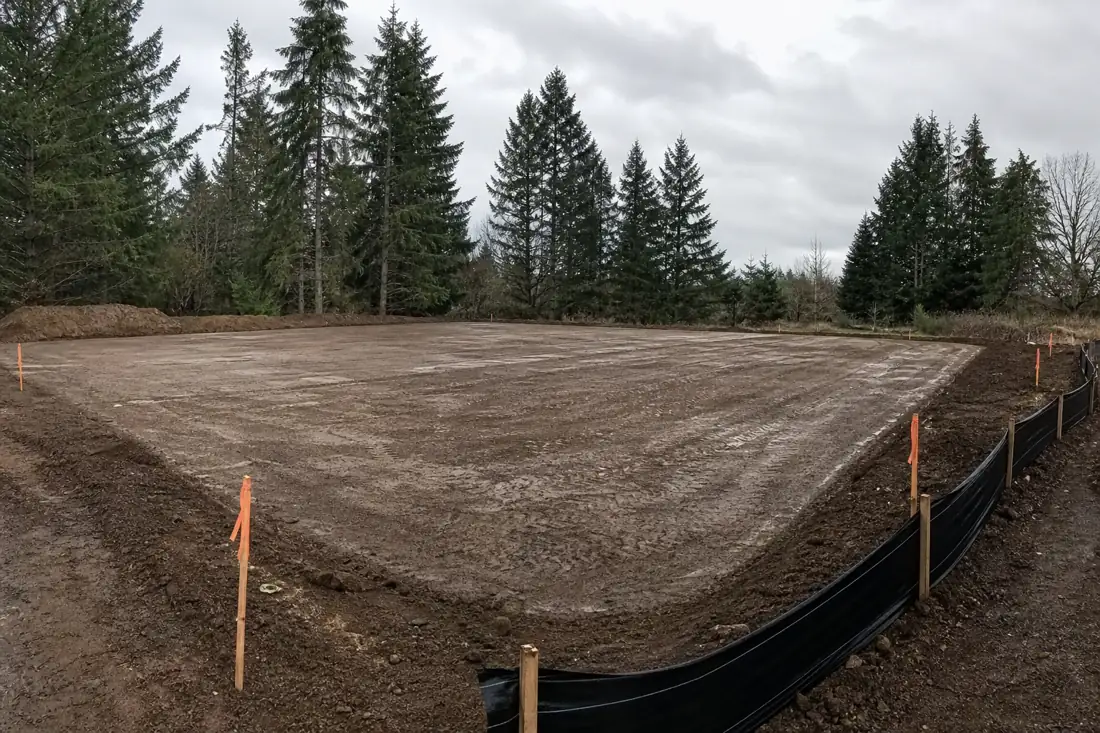
Machine stripping topsoil from agricultural parcel during building
    pad site preparation near North Plains, OR
Stripping the plow layer and stockpiling topsoil as usable material is the right first step on farmed ground in the North Plains area.

What Site Preparation on Agricultural Parcels Actually Requires

Farmed ground has a specific layered structure that affects every step of pad preparation. The sequence below is not optional — it is the mechanical reason the pad holds:

Owners who treat over-excavation as a line item to negotiate away are usually looking at the wrong cost. The cost of correcting differential settlement after a slab is poured is measured in concrete cutting, mudjacking, or demo and repour. Working with excavation contractors in Hillsboro, OR who treat subgrade investigation as standard practice rather than extra service keeps that cost off the table.

Why Farmed Ground Fools Contractors Who Do Not Know It

A plow layer can look identical to a stable subgrade on the surface. Both are dark, both respond to foot traffic the same way in dry summer conditions, and neither shows a visible problem until machine weight concentrates the load. The difference is density and organic content. The plow layer typically runs from four to ten inches deep depending on how the ground was worked, and below it the compaction from tillage machinery creates a layer that is denser than the plow layer but still contains the original silty clay matrix of the Tualatin Valley. That silty clay expands when saturated and shrinks when dry. If you build a pad over it without stripping and addressing both layers, the pad will move seasonally with the moisture cycle.

Topsoil as an Asset, Not a Disposal Problem

On farmed ground, stripped topsoil is often genuinely valuable. It is already developed organic material that supports landscaping, seeding, and finish grading. Rather than hauling it off the site and paying a tipping fee, we stockpile it on an undisturbed area away from the work zone, protect it with erosion-control measures as Clean Water Services requires, and spread it back once the structural work is complete. That approach avoids a disposal cost and a later purchase. It is part of how our Hillsboro excavation crews plan agricultural site prep from the start rather than treating the topsoil as an afterthought.

Access, Permits, and Schedule on a Rural North Plains Parcel

Rural parcels off U.S. 26 near North Plains often have a single long driveway or field approach that was not designed for repeated truck traffic under load. During the October through May wet season, a soft clay approach can rut badly in the first week, creating a problem that costs more to fix than the crushed rock needed to stabilize it before work starts. We assess the approach as part of every site preparation estimate because a machine stuck in a rutted field road is a day of lost production. Washington County permits apply to grading and fill work on these parcels, and if the project disturbs one acre or more the Oregon DEQ 1200-C permit is required before any ground is broken. We factor permit lead times into the schedule from the first conversation.

Site preparation cost on a North Plains agricultural parcel depends on how deep the topsoil runs, whether the subgrade is stable or requires over-excavation, how far the fill haul runs, and what the approach condition demands. After a site visit in dry conditions we can probe the topsoil depth across the pad footprint and give you a realistic base estimate with conditional items for deeper excavation if the subgrade warrants it. The Hillsboro excavation crew works through the Tualatin Valley regularly and knows what typical agricultural subgrades look like here — which means the conditional items we quote are tied to actual findings, not worst-case padding.

Excavation Services We Provide in North Plains

Agricultural site preparation near North Plains requires a different approach than raw land. Explore the full range of services from excavation contractors in Hillsboro, OR.

Drainage & French Drains

Drainage & French Drains →

Site Preparation

Site Preparation →

Utility Trenching

Utility Trenching →

Grading & Leveling

Grading & Leveling →

Frequently Asked Questions

Why does farmed ground require more excavation than raw land?

Because the plow layer — the top four to ten inches of tilled soil — is loose, organic, and will not compact to structural density. Below it, the natural subsoil is often workable, but you have to get through the plow layer first. Skipping the strip means building your pad on a compressible layer that behaves differently than the fill above it, which causes differential settlement. The extra excavation removes the problem rather than covering it.

What is compaction testing and why is it required?

Compaction testing measures the density of each fill lift against a lab-determined maximum for that material. The result tells you — and your structural engineer — whether the fill is dense enough to support the design load without settling. Testing each lift, not just the finished surface, is how you know the density is consistent through the full fill depth rather than just at the top where a roller can fake it.

Can you just add gravel on top of the existing ground?

No. Gravel placed on a compressible plow layer will punch through it under load. The base material has to be capable of supporting the load first; the gravel above it distributes that load. Adding gravel without stripping the soft material changes the appearance without changing the structural behavior. The pad will still settle, it will just take slightly longer to show up.

What do you do with the topsoil you strip?

We stockpile it on an undisturbed area of the parcel away from the work zone and protect it with erosion-control measures per Clean Water Services requirements. At the end of the project it goes back for finish grading around the structure. On farm parcels the topsoil is already good material — keeping it avoids a disposal cost and the cost of buying screened topsoil later.

What does site preparation cost on a farmed parcel near North Plains?

It depends on topsoil depth, subgrade stability, fill haul distance, and access condition. A pad on firm subsoil with a short topsoil strip and a good access road costs less than one requiring deep over-excavation and access stabilization. We visit the site, probe the topsoil across the pad footprint, and give you a base cost with clear conditional items. That way your budget reflects your specific ground, not a regional average.

When is the right season to do site prep near North Plains?

The best window is June through September when the Tualatin Valley silty clay is driest and firmest. Compaction work done in dry conditions holds better and tests better than the same work done in saturated soil. The October through May wet season does not make work impossible, but it slows haul operations, puts more wear on the approach road, and makes compaction testing results less predictable. We schedule around the dry window where the project timeline allows.
Get Your Free Hillsboro Excavation Estimate

Tell us about your project and we will come walk the site and give you a straight, itemized quote — no obligation, no pressure. Call us, or send the form and we will get back to you the same business day.

We only use your info to contact you about your project. No spam, ever.

Prefer to talk?

Call or text and reach us directly. We answer during business hours and return every message.

(971) 397-9361

Hours: Mon–Sat, 7am–6pm