Serving Hillsboro & all of Washington County, OR Free estimates: (971) 397-9361
Hillsboro Excavation Co.

Home › North Plains

Utility Trenching in North Plains, OR

North Plains parcels often require utility lines running hundreds of feet across open agricultural ground — a different challenge than short in-town laterals.

Licensed & insured in Oregon Free on-site estimates Local Washington County crew Wet-season ready

Utility trenching in North Plains, OR operates on a different scale than urban lateral work. The city limits cover only 0.90 square mile, but the agricultural and wooded parcels surrounding them regularly require power, water, or septic lines that run hundreds of feet from a road to a building site rather than the thirty or forty feet typical of an in-town lateral. Hillsboro Excavation Co. handles those long runs with equipment sized for the distance and crews who plan the full route before the machine turns the first wheel of soil.

North Plains sits off U.S. 26 on the northwest outskirts of the Portland metro. Summers here can push above 100°F for several consecutive days — one of the hottest pockets in Washington County — which matters because a long open trench that must stay accessible over multiple days does so in weather that dries the trench walls unevenly and accelerates the curing of concrete encasements. Planning the work window around temperature and soil conditions is not optional when the trench has to remain open while pipe is inspected, joints are tested, and backfill cannot begin until an inspector signs off.

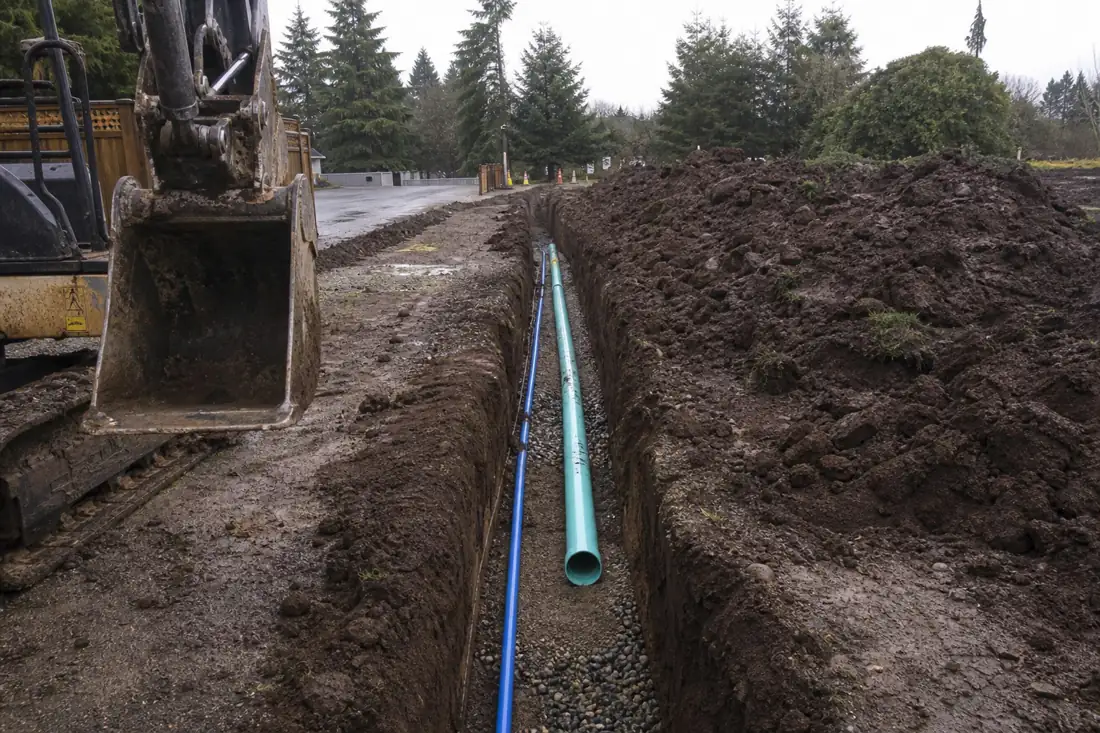
Long utility trench across agricultural land near North Plains, OR with pipe laid in crushed-rock bedding
A long rural run requires careful route planning, full-length bedding, and staged backfill across the entire distance.

How a Long Rural Trench Differs From an Urban Lateral

A run of several hundred feet across open agricultural ground changes nearly every element of the job compared to a short in-town lateral. Understanding those differences helps owners schedule and budget accurately before mobilization.

None of these factors are unique to North Plains, but they combine on rural parcels in a way that makes rural trenching a distinct discipline from the short laterals that make up most urban utility work. Excavation contractors in Hillsboro, OR who work primarily in town often underestimate what a 400-foot agricultural run actually demands.

Unmarked Lines and the Agricultural Subsurface

Agricultural land in the Tualatin Valley was systematically drained through the early and mid-twentieth century using clay tile laid in herringbone or parallel patterns across fields. The tile collected groundwater and carried it to a ditch or outlet, improving trafficability for equipment and increasing yields. No permit was required, no as-built drawings were filed, and the tile has often been in the ground for sixty to ninety years without a maintenance record. When a trench crosses one of these lines, the machine operator either cuts through the tile — severing the drainage of a large area of field — or the trench itself intercepts the drainage flow and turns into a wet ditch that cannot be safely worked in until pumped down. Either outcome adds time and cost that was not in the original estimate. The only way to reduce the risk is to walk the route, look for surface indicators like subtle depressions or outlet pipes at ditch banks, and have a conversation with the landowner about what drainage work has been done over the years.

The Summer Window and Why It Matters on Long Runs

North Plains summers can exceed 100°F for multiple consecutive days. That heat dries the top few inches of a trench wall quickly while the deeper soil stays moist, creating differential conditions that affect wall stability and, more practically, working conditions for the crew and curing conditions for concrete bedding or thrust blocks. A trench that must remain open three or four days while pipe is inspected and joints are pressure-tested benefits from being scheduled in the warmest, driest period available — typically July and August in Washington County. The October-to-May wet season brings the Tualatin Valley’s high water table and regular rainfall that fills open excavations and can saturate backfill before compaction is finished. Our Hillsboro excavation team builds the weather window into the project schedule rather than hoping conditions cooperate after mobilization.

Scheduling, Permits, and the Real Cost of a Rural Run

A long utility trench on a rural North Plains parcel involves permitting at multiple levels. A right-of-way permit is required to cross U.S. 26 or any county road, and those permits may specify bore-under rather than open-cut to maintain traffic flow. Connecting to a public water main requires a Washington County permit and inspection. A new septic system or drain field requires an Oregon DEQ site evaluation and permit before excavation begins. If the total disturbed area across the trench route reaches one acre, the Oregon DEQ 1200-C stormwater permit applies and a stormwater pollution prevention plan must be in place before ground is broken. Stacking these permits and coordinating inspections across agencies adds lead time that is invisible in the ground but very visible in the project timeline.

The actual trench cost on a rural parcel breaks down differently than most owners expect. Mobilization and demobilization are fixed costs that do not change with run length. Machine time per foot on open agricultural ground is fast, often faster than urban work where traffic control and tight quarters slow the equipment. But restoration — replacing topsoil, re-seeding, re-establishing crop ground to functional drainage, and restoring any graveled field access that was disrupted — scales directly with every foot of trench. On a 400-foot run, restoration is a material line item, not an afterthought. The Hillsboro excavation crew provides a route-by-route quote that separates machine time, bedding material, permit fees, and restoration so owners know exactly where the money goes before they commit.

Excavation Services We Provide in North Plains

Reach out to excavation contractors in Hillsboro, OR for a route evaluation before committing to a trench length or budget on a rural parcel.

Drainage & French Drains

Drainage & French Drains →

Site Preparation

Site Preparation →

Utility Trenching

Utility Trenching →

Grading & Leveling

Grading & Leveling →

Frequently Asked Questions

How does run length affect the cost of utility trenching near North Plains?

Mobilization cost is fixed regardless of trench length, so longer runs lower the per-foot machine rate but raise total project cost. On a 400-foot agricultural run, mobilization might represent fifteen percent of the total rather than forty percent on a 50-foot lateral. However, restoration — replacing topsoil, re-seeding, and restoring any field access — scales directly with distance and becomes a major line item on long rural runs. We separate these components in every quote so you know what drives the number.

What is agricultural drain tile and why does it matter?

Drain tile is perforated clay or concrete pipe laid in a systematic pattern beneath farm fields in the early and mid-1900s to carry groundwater to a ditch or outlet. No permit was required and no records were filed, so these lines do not appear on any 811 locate ticket. Cutting one with a machine severs the drainage for a potentially large section of field and can flood the trench before the operator realizes what happened. We walk the route and ask landowners about drainage history before machine work begins on any agricultural parcel.

Can you cross a driveway or field access without cutting off vehicle traffic?

Yes. A driveway crossing is typically handled by boring under it or by plating the open cut with steel road plates rated for vehicle loads. Boring leaves the driveway surface untouched and is the preferred method when the driveway is paved or has a base that would be difficult to restore. Road plating allows an open cut but keeps the surface passable throughout the job. We determine the right approach based on the crossing depth, the load rating needed, and how long the trench will remain open at that location.

Why do unmarked irrigation lines cause problems on rural trenches?

Most agricultural irrigation systems are PVC pipe installed without metallic tracer wire, which means a standard electromagnetic locating tool cannot find them. They are often buried at inconsistent depths depending on how the field was graded over the years. A machine operator working through a field can sever an irrigation lateral without any warning and without any locate ticket that should have flagged it. Talking to the landowner, looking for riser locations, and understanding the field layout before digging is the only practical mitigation.

How much does utility trenching typically cost on a rural North Plains parcel?

Rural trench costs depend on run length, depth, soil type, permit fees, and restoration requirements. A straightforward 200-foot water line in clean ground costs less per foot than a 400-foot run that crosses a driveway, requires boring under a county road, and must restore crop ground to original drainage function. Permit fees for rural connections can add several hundred dollars or more. We provide a full route-by-route quote after a site visit rather than a per-foot estimate, because rural sites vary too much for flat-rate pricing to be reliable.

When is the best time of year to schedule a long open trench near North Plains?

July and August are the most reliable window. North Plains summers can exceed 100°F, which dries the trench walls quickly and keeps groundwater depressed, allowing a long trench to stay open over multiple days without significant water management. The October-to-May wet season brings the Tualatin Valley high water table and regular rainfall that fills open excavations fast and saturates backfill before compaction is complete. If a job must happen outside the summer window, we plan for dewatering and allow more time for each phase of the work.
Get Your Free Hillsboro Excavation Estimate

Tell us about your project and we will come walk the site and give you a straight, itemized quote — no obligation, no pressure. Call us, or send the form and we will get back to you the same business day.

We only use your info to contact you about your project. No spam, ever.

Prefer to talk?

Call or text and reach us directly. We answer during business hours and return every message.

(971) 397-9361

Hours: Mon–Sat, 7am–6pm