Serving Hillsboro & all of Washington County, OR Free estimates: (971) 397-9361
Hillsboro Excavation Co.

Home › Gaston

Demolition in Gaston, OR

Most demolition in Gaston involves aging agricultural structures on river-adjacent ground where seasonal scheduling, erosion control, and stored-material clearance determine the timeline.

Licensed & insured in Oregon Free on-site estimates Local Washington County crew Wet-season ready

Demolition near the Tualatin River in Gaston involves a layer of site planning that most residential teardowns never require. Gaston borders the river and sits on silty clay ground that drains slowly, supports heavy equipment only part of the year, and is scrutinized under Clean Water Services erosion rules because disturbed soil here has a direct path to the water. Hillsboro Excavation Co. handles the agricultural structures that make up much of the demolition work in this area—barns, outbuildings, sheds, and concrete foundations that have occupied their footprints for fifty years or more—and the approach to each one accounts for what the ground, the season, and the river proximity require.

Gaston occupies 0.28 square miles and borders the Tualatin River, straddling Oregon Route 47 between Forest Grove to the north and Yamhill to the south. The agricultural parcels surrounding the town are typical Tualatin Valley ground: silty clay that firms up in summer and turns soft and saturated by late October. The Atfalati band of the Kalapuya were the first known inhabitants of this area, and the land has been worked continuously since European settlement in the nineteenth century. That history means the farm structures still standing on many parcels were built with methods and materials that do not match current residential construction, and taking them down requires a different set of decisions than a house demolition on a paved street.

Before equipment arrives on a river-adjacent site, the erosion and sediment control plan has to be in place. Clean Water Services reviews disturbed-ground projects that drain toward the Tualatin River, and the standard for containment is higher here than on an upland parcel far from any waterway. That is not a bureaucratic obstacle—it is a real constraint that reflects the fact that sediment from a construction site moves into the river during rain events and causes downstream harm that is difficult and expensive to reverse.

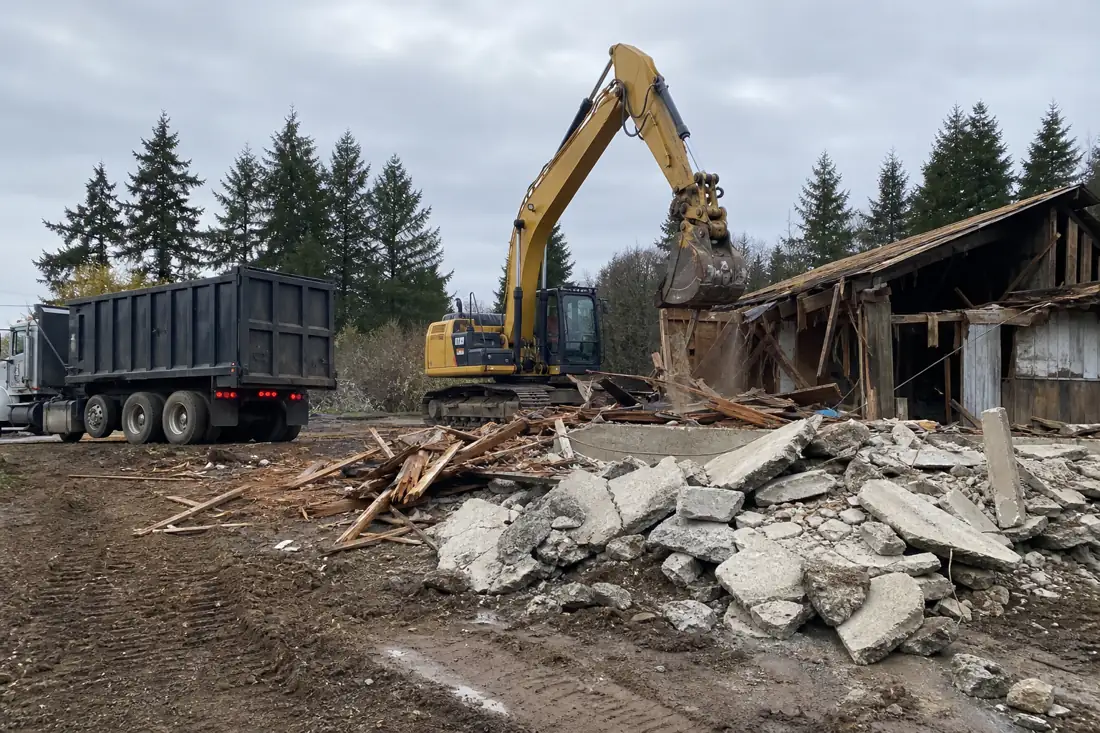
Demolition of aging agricultural barn structure on river-adjacent ground near Gaston, OR showing equipment approach
Agricultural demolition near the Tualatin River requires erosion planning, material inventorying, and dry-season scheduling before equipment mobilizes.

Why Farm Buildings Come Down Differently

Agricultural structures in the Gaston area were built over many decades using materials and methods that differ substantially from modern residential construction. Understanding those differences before demolition begins determines which equipment sequence works safely and what materials the site will generate. Here is what sets farm building teardowns apart.

Working through these variables in sequence rather than discovering them mid-demo keeps the project on schedule and within budget. The excavation contractors in Hillsboro, OR who know Clean Water Services requirements can prepare the site plan and documentation ahead of time so those permits are ready before mobilization, not pending when work is already underway.

Seasonal Constraints on River-Adjacent Ground

The ground around Gaston follows a clear seasonal pattern that determines when heavy equipment can operate without causing lasting damage to the site. From roughly June through September, the silty clay firms up enough to support a loaded excavator and haul trucks without significant rutting. Starting in October and running through May, that same soil holds water near the surface, and heavy equipment movement across a wet field compacts the subsoil in a way that persists for years — reducing drainage, limiting root depth in the remaining field, and creating depressions that collect standing water. River-adjacent parcels face an additional layer of constraint: disturbed ground that drains toward the Tualatin River can shed sediment into the water during rain events even with silt fencing in place, triggering active oversight from Clean Water Services. The dry season is not just a preference for comfort; it is the operational window where the site can be disturbed, worked, and stabilized before the rains begin in earnest.

What Erosion Control Requires When You Border the Tualatin River

On an upland site away from waterways, a silt fence at the perimeter satisfies the basic erosion-control requirement for most small demolition projects. On a Gaston parcel that borders or drains directly toward the Tualatin River, the threshold is different. Clean Water Services requires an erosion and sediment control plan for disturbed ground near the river, and if the project disturbs an acre or more of total area, the Oregon DEQ 1200-C stormwater permit applies in addition to the county demolition permit. That permit requires a site-specific plan with designated stabilization methods, not a standard form. Our Hillsboro excavation team prepares the required documentation before mobilizing so inspectors have what they need on the first site visit. Starting work without the erosion plan in place can halt a project mid-demo, and resuming requires bringing the site back into compliance before any additional disturbing work can happen—an outcome that costs more than the plan itself.

Permits, Scheduling, and Honest Timelines for Gaston Agricultural Demolition

The permit process for agricultural structure demolition in Washington County begins with the county demolition permit and extends to environmental clearances when hazardous materials are found inside the structure. Asbestos-containing materials and lead-based paint are common in farm buildings built before 1978, which describes most of the aging agricultural stock in the Gaston area. Oregon DEQ rules require a licensed inspector to test suspect materials before demolition and a certified abatement contractor to remove any confirmed hazardous materials before mechanical work begins. Abatement contractors operate on their own scheduling calendars, and that work cannot be compressed without violating regulatory requirements. The abatement step is time-fixed, which means it has to be built into the front end of the project schedule rather than treated as a quick checkbox that happens the week before planned demo. Leaving it out of the initial timeline is how projects that should take three weeks end up taking eight.

The honest answer about when a Gaston teardown can begin is that it depends on the calendar, the condition of the ground, and what is found inside the structure during the pre-demo inspection. Some jobs can proceed in the wet season with careful haul routing limited to hard surfaces. Others genuinely need dry ground before equipment can access the footprint without causing damage that would cost more to repair than the demo itself saves. The Hillsboro excavation crew gives a straight assessment of what is possible after walking the site—including the cases where the right answer is to wait for summer rather than push equipment across wet field ground in December and create a compaction problem that lasts for years.

Excavation Services We Provide in Gaston

Serving Gaston and Washington County with agricultural demolition, erosion planning, and site preparation near the Tualatin River — contact the excavation contractors in Hillsboro, OR who plan the whole job before mobilizing.

Drainage & French Drains

Drainage & French Drains →

Site Preparation

Site Preparation →

Utility Trenching

Utility Trenching →

Grading & Leveling

Grading & Leveling →

Frequently Asked Questions

Are there extra permits for demolishing an agricultural structure near the Tualatin River in Gaston?

River proximity adds requirements beyond the standard Washington County demolition permit. Clean Water Services has jurisdiction over erosion and sediment control for ground disturbed near the Tualatin River, and a site-specific erosion plan is required before work begins. If the total disturbed area reaches an acre or more, the Oregon DEQ 1200-C stormwater permit applies on top of the county permit. Most individual agricultural structures fall short of an acre, but the Clean Water Services review applies regardless of size when the drainage path leads toward the river.

What needs to happen to materials stored inside a barn before demolition in Gaston?

Every material inside the structure has to be inventoried and removed before mechanical demolition begins. Agricultural buildings commonly contain fuel drums, pesticide containers, lubricants, antifreeze, and other chemicals that require licensed disposal under Oregon DEQ rules. Equipment, tools, and stored goods in good condition can sometimes be sold or donated. Damaged containers or chemical waste go to a licensed disposal contractor. Skipping this step and burying old chemical containers under demolition debris creates a contamination liability that surfaces during any future excavation on the property.

How do I find out if there are buried drain tiles or irrigation lines under a farm structure in Gaston?

In most cases there is no reliable record. Agricultural drain tile was installed without engineering drawings on most Tualatin Valley parcels, and irrigation laterals from past operations may have no documentation at all. The standard approach is to call 811 to mark any known utility locations, then excavate carefully with the operator watching for tile encountered during digging. A severed drain tile line needs to be capped and redirected before the demo is complete, otherwise the field drainage pattern changes in ways that affect the remaining ground for years.

Can demolition of a farm building happen in winter near Gaston?

The structure itself can come down in any weather. Moving the material out without damaging the ground is the limiting factor. Silty clay soil around Gaston stays wet and soft from October through May, and running loaded haul trucks across that ground in December causes compaction and ruts that take years to recover. Whether a winter project is feasible depends on whether the haul route can be limited entirely to hard surfaces. If the only path from the structure to the road crosses soft field ground, waiting for dry conditions costs less than repairing the access after the fact.

How is agricultural demolition priced differently from residential demolition in Gaston?

The main cost differences are material handling complexity and site access. Farm buildings produce large concrete slabs, heavy timber, and mixed debris that takes more time to sort and generates multiple haul loads at different disposal costs than standard residential framing. Hazardous material testing and abatement, if required, add a separate line item before mechanical work begins. Field access across soft or unimproved ground adds truck wear and setup time that a paved-access site does not. An accurate price for an agricultural structure in Gaston requires a site visit to understand all of those variables.

When is the right time to start planning a Gaston agricultural demolition?

Several months before the target start date. Hazardous material testing, abatement scheduling, permit processing, and erosion plan preparation run sequentially rather than in parallel. If the goal is a summer teardown when ground conditions allow full equipment access, the planning process should start in late winter or early spring. The mechanical demolition phase is often the shortest part of the total timeline. The lead work — testing, permitting, abatement, and site planning — is what controls when equipment can actually mobilize and work without regulatory or ground-condition delays.
Get Your Free Hillsboro Excavation Estimate

Tell us about your project and we will come walk the site and give you a straight, itemized quote — no obligation, no pressure. Call us, or send the form and we will get back to you the same business day.

We only use your info to contact you about your project. No spam, ever.

Prefer to talk?

Call or text and reach us directly. We answer during business hours and return every message.

(971) 397-9361

Hours: Mon–Sat, 7am–6pm