Serving Hillsboro & all of Washington County, OR Free estimates: (971) 397-9361
Hillsboro Excavation Co.

Home › Cornelius

Drainage & French Drains in Cornelius, OR

On the flat Tualatin Valley floor, drainage fall has to be engineered into the site—not found in it.

Licensed & insured in Oregon Free on-site estimates Local Washington County crew Wet-season ready

Standing water in a Cornelius yard, a soggy crawl space, or a basement that takes on moisture every winter is not simply a nuisance—it is a sign that the ground is holding water it cannot move. The fix is a drainage system designed around one rule: water flows downhill. That rule is easy to satisfy on sloped ground and genuinely hard to satisfy in Cornelius, where the Tualatin Valley floor gives almost nothing in the way of natural gradient. Hillsboro Excavation Co. installs French drains, surface drains, and catch basins throughout Cornelius, and every job begins with a site survey and outlet confirmation before a trench is planned.

The soil under Cornelius is Tualatin Valley silty clay, a tight-grained material that sheds water horizontally rather than letting it drain vertically into the ground. When rainfall saturates the top few inches of clay, the water table rises quickly—sometimes to within a foot of the surface during back-to-back wet weeks in the October through May rainy season. The clay holds that saturation long after the rain stops. Perforated pipe laid in clay with no outlet lower than its inlet will fill with water and stay full, accomplishing nothing except giving a homeowner the impression that drainage work was done. A French drain with no outfall is just a buried trench that fills up and stays full.

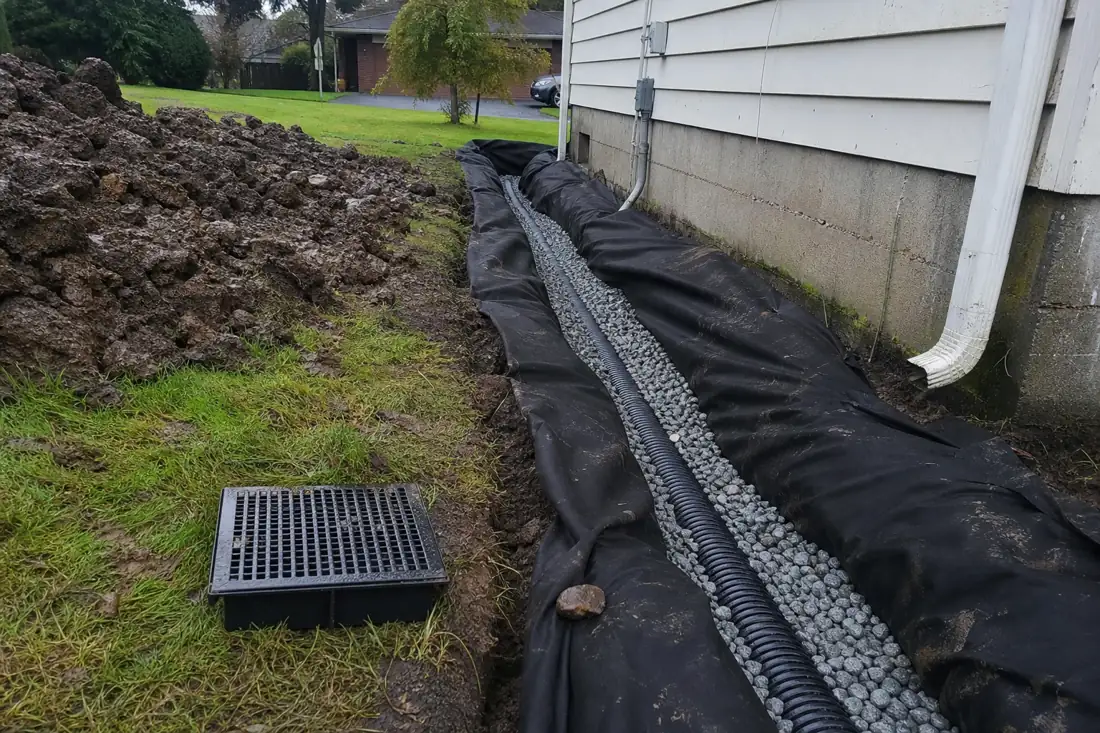
French drain trench with perforated pipe and gravel installed on a flat residential lot in Cornelius, OR
Perforated drain pipe bedded in washed gravel and wrapped in filter fabric, graded to a confirmed outlet on a flat Tualatin Valley lot in Cornelius.

What a Drainage System on Flat Ground Actually Requires

A functioning French drain is not just perforated pipe and gravel—it is a complete system with a defined collection zone and a legal, lower-elevation outlet. On terrain with natural fall, finding the outlet is straightforward. On Cornelius lots, the outlet has to be located or created before any pipe is routed, which means the design phase is longer and more methodical than on sloped suburban sites.

The sequence above describes the design steps that must be completed before the installation begins. What makes the Cornelius context distinct is the amount of pre-dig work the design requires. A site with topographic relief might need a brief site walk to identify a downhill outlet; a lot on the flat Tualatin Valley floor may need an hour of leveling and outlet research before the crew can say with confidence where the pipe will run and whether the outlet elevation actually clears the inlet. Getting that confirmation on paper before the machine starts is what separates a drain that works from one that holds water.

These steps feed into a single fixed-price quote—there is no shortcut that omits the survey phase—which is why excavation contractors in Hillsboro, OR treat the site walk and elevation check as part of every drainage project rather than an optional step that can be skipped when the schedule is tight.

Why Cornelius Lots Make Outlet Engineering Non-Negotiable

Cornelius covers 2.340 square miles of land and is home to 4,843 households. That density means the average residential lot is compact, with neighboring structures close on every side. There is no spare land on the property to daylight a drain into a private swale, and the neighbor’s yard—a few feet away and at nearly the same elevation—does not accept discharge legally or practically. Discharging onto an adjacent property is a trespass even when the neighbor does not object in the moment; it also accomplishes nothing on flat ground where the neighbor’s lot drains no better than yours. The outlet has to be a public infrastructure connection or a subsurface structure that keeps the water entirely on the originating property until it dissipates into permeable material below the clay.

Engineering Fall Into a Flat Trench

A standard perforated drain pipe needs approximately one inch of fall per eight feet of horizontal run to keep water moving toward the outlet without pooling inside the pipe. On a Cornelius lot where the surface elevation varies by only a few inches across its full width, that minimum fall has to come from the trench depth, not from the ground surface above it. The excavator digs progressively deeper as it moves toward the outlet end, creating an artificial gradient in the pipe invert even when the lawn above remains nearly level. Confirming that gradient with a laser level or builder’s transit before backfilling is the only reliable way to know the system will function—and that field check is a standard step in every Hillsboro excavation drainage installation, not an optional add-on charged separately. Re-grading a backfilled trench because the gradient was assumed rather than measured costs roughly as much as the original job.

Permits, Timing, and What Drives the Installed Cost

Drainage work in Cornelius begins with an 811 utility locate—Oregon law requires calling before any digging, and the locate identifies buried gas, water, sewer, and electrical lines that directly affect the routing of any trench. Work that opens a city right-of-way to install a curb outlet requires a City of Cornelius encroachment permit; processing typically takes two to three weeks. Projects that disturb an acre or more of ground trigger the Oregon DEQ 1200-C stormwater permit and must also comply with Clean Water Services erosion-control standards under Washington County’s jurisdiction. Most residential French drain installations stay well below the one-acre threshold, but the encroachment permit is common whenever the outlet connects to public infrastructure, and its lead time is not negotiable. Homeowners who call in late September to get a system in before the October rains begin are already at the edge of the permit window.

Installed cost depends on pipe run length, trench depth, outlet type, and whether existing hardscape or landscaping must be removed and restored. A straightforward lateral drain running to a curb cut is at one end of the range. A multi-zone system covering both a backyard and a crawl space, terminating in a drilled dry well, is at the other. Neither number is accurate when quoted over the phone. The Hillsboro excavation crew provides a fixed-price quote after walking the site with a level and confirming the outlet elevation, because variables such as a buried utility in the planned trench path, an outlet that requires a more complex storm-system connection, or unexpected rock encountered at depth all affect the final scope and are not visible until someone measures the property in person.

Excavation Services We Provide in Cornelius

Cornelius homeowners dealing with standing water or a wet crawl space need a drainage system designed for flat ground, starting with a confirmed outlet—contact excavation contractors in Hillsboro, OR for a site-walk quote.

Drainage & French Drains

Drainage & French Drains →

Site Preparation

Site Preparation →

Utility Trenching

Utility Trenching →

Grading & Leveling

Grading & Leveling →

Frequently Asked Questions

Why doesn’t a standard French drain work on flat ground in Cornelius?

A French drain moves water from a saturated zone to an outlet that sits at a lower elevation. On sloped land, that lower point is easy to find. On Cornelius lots, which sit on the nearly level Tualatin Valley floor, there is often no lower elevation available within the property boundary. Without a confirmed outlet, a perforated pipe in a gravel trench simply collects water until the trench is full, then stops accepting more. The system works only when an outlet is located or engineered before any pipe is laid.

What outlet options exist when there is no natural fall on a Cornelius lot?

Three options cover most residential situations. First, a curb drain discharging to the street gutter, which requires a City of Cornelius encroachment permit but is often the most direct route. Second, a direct connection to the municipal storm system if the property has an available lateral. Third, a dry well drilled or excavated below the silty clay layer into gravel or fractured basalt, which dissipates water into more permeable material underground. The right choice depends on soil depth, available permit lead time, and how close the property sits to a public storm line.

How does the October to May rainy season affect drainage project scheduling in Cornelius?

The wet season compresses scheduling from both ends. Ground that is already saturated before a project starts makes trenching slower and spoil management harder because the excavated clay holds moisture and weight. On the permit side, encroachment permits for curb outlets can take two to three weeks, so projects requested in late September often land right at the start of sustained rains. The practical window for planning and permitting is late summer, with installation timed to complete before October. Emergency repairs can be done in winter but cost more because of wet-ground conditions and accelerated scheduling.

Do you need a permit to install a French drain on a residential lot in Cornelius?

It depends on the outlet. A French drain contained entirely within a private property and terminating in a dry well generally does not require a permit beyond the 811 utility locate. Work that opens the city right-of-way to connect a curb outlet requires a City of Cornelius encroachment permit. Projects disturbing an acre or more of soil also require an Oregon DEQ 1200-C stormwater permit. Most residential jobs fall below the acre threshold but do involve a curb outlet, so the encroachment permit is the common requirement. Permit requirements are confirmed during the site visit before any quote is finalized.

What does drainage installation cost in Cornelius, OR?

Cost varies with run length, trench depth, outlet type, and how much existing landscaping needs to be removed and restored. A short lateral drain from a low foundation corner to a street curb cut sits at the lower end of the range. A multi-zone system covering a full backyard and crawl space, ending in a drilled dry well that goes below the silty clay layer, sits at the higher end. The exact number is not knowable without a site visit and outlet elevation confirmation. Providing a quote before measuring the property produces a number that is almost always wrong, which is why a field visit comes first.

How do you verify the pipe gradient on a flat lot before backfilling?

A laser level or builder’s transit is set up at the pipe invert at the high end of the run and a rod reading is taken at the outlet end. The difference in those readings divided by the run length gives the actual slope. Standard French drain pipe requires roughly one inch of fall per eight feet of run; if the trench delivers less than that, the pipe depth at the outlet is adjusted before the gravel is placed. This check takes fifteen minutes and eliminates the risk of discovering a flat or back-pitched run after the trench is already backfilled.
Get Your Free Hillsboro Excavation Estimate

Tell us about your project and we will come walk the site and give you a straight, itemized quote — no obligation, no pressure. Call us, or send the form and we will get back to you the same business day.

We only use your info to contact you about your project. No spam, ever.

Prefer to talk?

Call or text and reach us directly. We answer during business hours and return every message.

(971) 397-9361

Hours: Mon–Sat, 7am–6pm