Home › Gaston
River-adjacent ground near the Tualatin River means a high, seasonal water table—drainage systems here have to be designed around dewatering from the start.
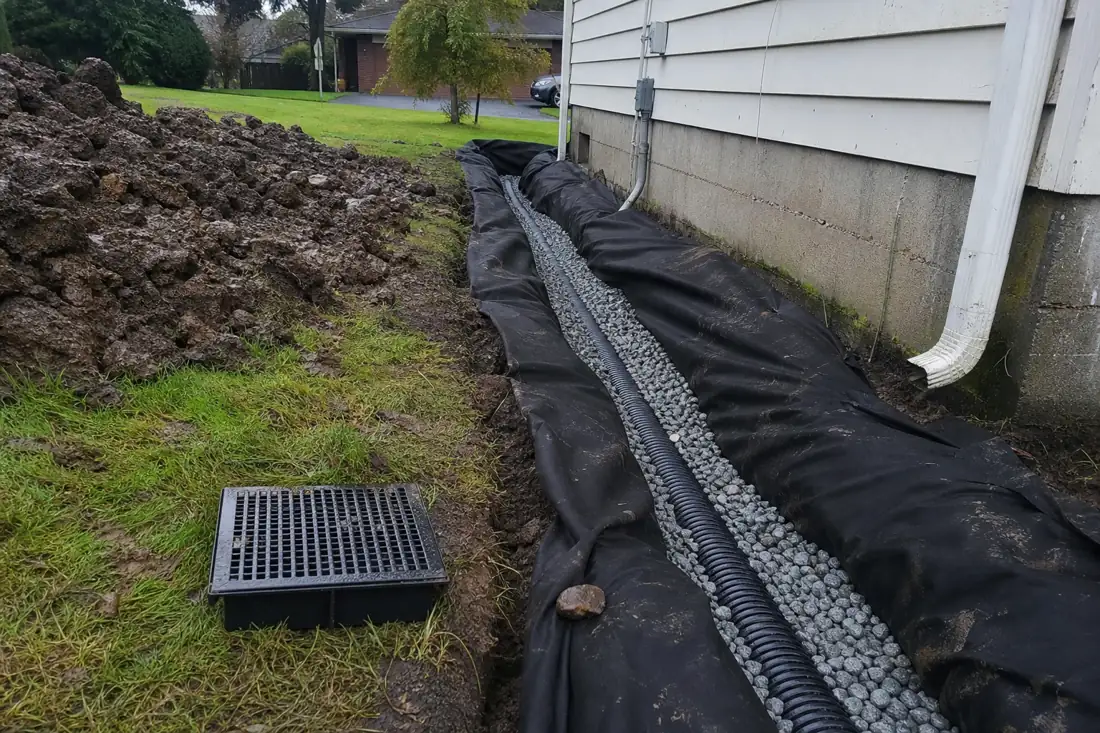
When a yard or field near Gaston starts collecting water, the cause is rarely a single failed drain. This close to the Tualatin River, the water table starts high and climbs higher as winter rain arrives, and any gap in surface drainage compounds quickly. Hillsboro Excavation Co. designs and installs French drains, interceptor trenches, and subsurface pipe systems sized for the seasonal load that river-adjacent ground actually imposes—not the load a dry-summer site survey might suggest.
The Tualatin River corridor deposits soil in layers rather than in a uniform profile. Silty clay, sandy lenses, and gravel beds can alternate within a few feet of depth, which means water does not move through the ground predictably. A trench that drains quickly in one corner of a property may intercept a clay lens and back up in another corner six feet away. Accurate drainage design here starts with reading the soil in multiple locations, not by assuming the whole site behaves the same as the first probe.
River-adjacent sites need drainage components that handle both surface runoff and rising groundwater. A standard French drain collects one source; a proper Gaston installation frequently needs to address both at once, because the water table can push up from below while rain loads the surface from above.
Sizing each component for the river-adjacent water table rather than average Tualatin Valley conditions is what separates a drain that functions through February from one that backs up by December. Our excavation contractors in Hillsboro, OR handle river-corridor drainage systems regularly across Washington County properties of all sizes.
Gaston borders the Tualatin River, and that proximity has two practical consequences that change how drainage must be designed and installed. First, the seasonal water table is high—by December it may sit within a foot or two of the surface in low areas, meaning any trench at that depth takes on water from below, not only from rain above. A trench that is completely dry in September can fill overnight in December with no storm event at all. Second, Clean Water Services erosion-control requirements carry extra weight on river-adjacent sites because sediment that leaves an open trench here has a short, direct path into the Tualatin. Exposed soil must be stabilized quickly and outlets must meet engineered standards—both are non-negotiable when a waterway is this close.
Much of the land surrounding Gaston is or was in agricultural use, and farm ground in the Tualatin Valley was routinely tiled for field drainage and irrigation over many decades. None of those lines appear in public locate databases. When you call 811, the system marks utility company infrastructure—it does not mark private agricultural tile, old irrigation mains, or historic drainage installations on private farm ground. An active tile cut during a summer excavation may not cause obvious flooding until heavy winter rain or the following season’s irrigation loads the system, and by then the connection between the dig and the problem is difficult to trace. Before breaking ground, our Hillsboro excavation crews review any available farm records and probe for tile evidence across the planned work zone, because discovering an active line mid-trench is expensive for every party involved.
Most residential and small-farm drainage projects in Washington County fall below the one-acre threshold that triggers Oregon DEQ’s 1200-C stormwater permit, but Clean Water Services erosion-control requirements apply to any site work disturbing soil near the Tualatin River corridor regardless of project size. That means an erosion-control plan, inspection checkpoints, and compliant outlet protection—all of which carry real costs that belong in any accurate estimate. On the pricing side, river-adjacent drainage runs higher than comparable work on upland sites because dewatering adds labor time, soil variability requires investigation before a pipe layout can be finalized, and outlet protection materials are not optional when a regulated waterway is adjacent.
Seasonal scheduling deserves a straight answer. If standing water is damaging a structure or preventing normal use of a property, the work gets done with dewatering equipment in place regardless of the season—that’s the point of planning for it upfront rather than being surprised by a saturated trench. If the problem is long-standing and the property owner can wait, summer work costs less: the water table has dropped, dewatering is minimal or absent, and soil investigation moves faster in dry conditions. The Hillsboro excavation crew gives a direct answer on timing in every estimate—we do not push summer jobs into winter to fill a schedule, and we do not discourage urgent winter calls when the situation genuinely warrants them.
For farms and residences along the Tualatin River corridor, excavation contractors in Hillsboro, OR who understand deposited river soils and seasonal water-table behavior make the difference between a drain that lasts and one that fails by February.
A standard French drain handles lateral surface and shallow subsurface flow. When the water table is seasonally elevated—as it is near the Tualatin in winter—a French drain alone may not be sufficient. An interceptor trench at the right depth and location can capture groundwater moving laterally through the soil profile before it reaches problem areas. The key is positioning the system to intercept that flow rather than trying to drain a water table that is rising from below.
River-deposited soils in the Tualatin corridor are layered and inconsistent. A permeable sandy lens next to a dense clay zone means water moves differently across even a small site. Without probing multiple locations, we cannot predict where an interceptor trench will actually intercept flow, how deep it needs to go, or how fast the pipe needs to move water. Pricing without that information produces a number that is either inflated to cover unknowns or undersized and wrong.
Clean Water Services is Washington County’s water resource agency, and their erosion-control standards apply to site work near the Tualatin River corridor regardless of project size. On a river-adjacent parcel, any exposed soil that can carry sediment toward a drainage path connected to the river requires stabilization measures and compliant outlet protection. The specific requirements depend on how close the work is to the waterway and the size of the disturbed area, but proximity to the Tualatin means inspectors look carefully.
No. The 811 public locate system marks underground lines owned by utility companies—gas, electric, telecom, and similar. Private agricultural drain tile and irrigation infrastructure installed on farm ground is not in any locate database. Fields around Gaston were actively tiled for drainage and irrigation for decades, and those networks are often still functional. The only way to identify them before digging is to review any available farm records, consult aerial photography, and probe the ground along the planned work zone.
River-adjacent drainage work costs more than the same linear footage on a dry upland site for three concrete reasons: dewatering equipment and labor add time, soil variability requires investigation before pipe layout can be confirmed, and Clean Water Services outlet-protection requirements add material cost. A short residential French drain on a straightforward site runs less than a system requiring an interceptor trench, dewatering, and engineered outlet protection on a property bordering the Tualatin corridor. We price after the site investigation, not from a linear-foot rate applied sight unseen.
Summer—roughly June through September—is cheaper and easier for most drainage work near the Tualatin: the water table is lower, dewatering is minimal, and excavation moves faster in drier soil. That said, drainage problems that are actively damaging a structure, causing crop loss, or creating a health concern cannot always wait. Those jobs get done in winter with dewatering planned in from the start. The decision comes down to what the water is doing to the property right now versus what waiting costs, which is a practical calculation, not a seasonal rule.
Tell us about your project and we will come walk the site and give you a straight, itemized quote — no obligation, no pressure. Call us, or send the form and we will get back to you the same business day.
Call or text and reach us directly. We answer during business hours and return every message.
(971) 397-9361Hours: Mon–Sat, 7am–6pm