Home › Gaston
On ground bordering the Tualatin River, a gravel driveway that holds through five winters is built from the subgrade up — the surface gravel is the last decision, not the first.
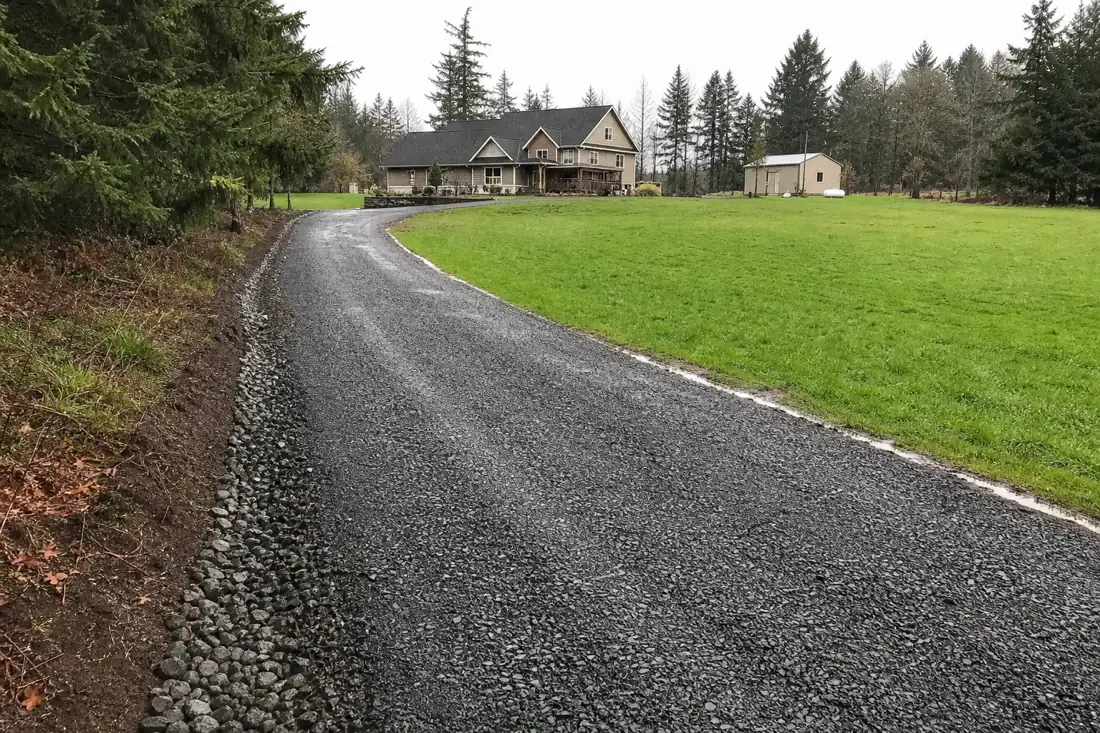
A gravel driveway in Gaston, OR faces conditions that a driveway three miles east on higher ground does not. Gaston is a community of 676 people on 0.28 square miles that borders the Tualatin River, and the ground here is saturated for months during the October-through-May wet season. Hillsboro Excavation Co. builds gravel driveways on this kind of ground, where the base course and what lies beneath it determine whether the surface holds up through five winters or begins to rut and soften within the first two. River proximity adds another layer: runoff from any disturbed soil on a Gaston-area site has a short path to the Tualatin River, which means erosion control during construction is not optional and receives closer attention from regulators than a site farther from the water would.
Gaston straddles Oregon Route 47 between Forest Grove to the north and Yamhill to the south, and was named for railroad executive Joseph Gaston. The Atfalati band of the Kalapuya were the first known inhabitants of the area. Most driveway projects in Gaston serve residential lots or small rural parcels where a functional year-round driveway is the difference between reliable access and an impassable mud track from November through April. The Tualatin River that borders the community falls within Clean Water Services jurisdiction, so sediment reaching the river during construction draws regulatory attention and the erosion-control measures required to prevent it are part of the job, not an afterthought added when an inspector arrives.
Building a gravel driveway on ground that borders the Tualatin River requires attention at each stage: subgrade, drainage structures, base placement, and erosion control during construction. The following items reflect the specifics of driveway work near Gaston.
The combination of soft river-adjacent subgrade and proximity to a regulated waterway makes Gaston driveways more demanding than a standard rural installation, which is why the excavation contractors in Hillsboro, OR evaluate subgrade conditions and drainage routing on the ground before providing a cost estimate.
Ground that borders the Tualatin River follows a consistent seasonal pattern. Through the summer, it dries out, the water table drops, and equipment can work on it without difficulty. Starting in October, rainfall recharges the water table, and by December the subgrade is at or near field capacity — holding nearly all the water it can. A driveway installed on saturated subgrade in this condition will behave differently once it dries: the soil shrinks and settles, the base course shifts with it, and the surface develops unevenness that gets progressively worse through subsequent wet seasons. A driveway installed on dry summer ground with geotextile fabric and a proper aggregate base will go through the same wet season intact, because the base and subgrade are not moving against each other. The difference between a July install and an October install on Gaston-area ground is not a matter of weather convenience; it is a structural outcome.
Clean Water Services manages water quality across the Tualatin watershed, and construction activity near the river is a priority enforcement area. Sites disturbing soil within proximity of the Tualatin are required to implement erosion and sediment controls before earthwork begins. Even for driveway projects that fall well below the one-acre threshold for a full Oregon DEQ 1200-C stormwater permit, basic controls at drainage outlets are required and enforced. The Hillsboro excavation crew installs sediment controls as a standard part of driveway work on river-adjacent ground, not as a billed extra, because addressing a stop-work order mid-project costs more in downtime and rework than doing it correctly from the start.
A new driveway connection to Oregon Route 47, which runs through Gaston, requires an access permit from the Oregon Department of Transportation before any construction begins. A connection to a Washington County road requires a county access permit. The driveway itself does not typically require a standalone permit, but earthwork disturbing an acre or more triggers the Oregon DEQ 1200-C stormwater permit and a Clean Water Services erosion-control plan. Most residential driveways in Gaston disturb less than an acre, but river proximity means that basic sediment controls are required regardless of project size. A pre-application conversation with the county and ODOT before starting work clarifies which permits apply to a specific parcel and prevents construction halts that occur when permit requirements are discovered after equipment is already on site.
Gravel driveway costs near Gaston run higher than on dry upland ground because the structural components required to keep a river-adjacent driveway functional are not optional upgrades. Geotextile fabric, extra base depth over soft subgrade, culverts at drainage crossings, and erosion controls during construction are baseline requirements on this ground. The Hillsboro excavation crew includes these items in the base quote for wet-ground sites so the estimate reflects the actual scope of work, rather than quoting a lower number against dry-ground assumptions and then adding structural requirements as change orders once excavation reveals the true subgrade conditions.
Hillsboro Excavation Co. builds gravel drives on the saturated river-adjacent ground around Gaston, where the base decides whether the surface survives winter — one service among many from excavation contractors in Hillsboro, OR.
Geotextile fabric prevents the aggregate base course from mixing with the silty clay subgrade. Near the Tualatin River, the subgrade stays saturated for months during the October-through-May wet season. Without fabric, vehicle loads push gravel down into soft clay and push clay up into the gravel; within a season the base course loses its drainage function and the surface develops persistent ruts. Fabric keeps the materials separated so the aggregate can do its job through the wet-dry cycles that define this ground every year.
Culvert size depends on the drainage area upstream of the crossing and the slope of the channel it replaces. An undersized culvert backs water up during heavy rain events, raises the water table along the full driveway length, and can overtop the road surface. Near the Tualatin River, undersized culverts also concentrate peak flow at the outlet, which accelerates erosion at the pipe exit and can deliver sediment directly to the watershed. Sizing requires knowing the upstream catchment area and the design storm for the site, which is determined during site evaluation.
Yes. Clean Water Services has jurisdiction over the Tualatin watershed and actively enforces erosion and sediment control requirements on construction sites near the river. Even for small driveway projects that stay under the one-acre threshold for a full stormwater permit, basic controls — silt fence, wattles, inlet protection at drainage outlets — are required before earthwork begins. A complaint from an adjacent property owner or a Clean Water Services inspector can result in a stop-work order until controls are in place, which disrupts the schedule and adds cost.
Summer is significantly better on river-adjacent ground near Gaston. From roughly June through September the water table drops, the subgrade firms up, and equipment can work without rutting the existing surface. Aggregate compacts correctly over dry, stable subgrade. A driveway built during this window goes into its first wet season with a settled, stable base. A fall or winter install is built on saturated ground that will shrink and settle as it dries, which means the surface often needs regrading after the first dry season even if the original installation was done correctly.
Costs on river-adjacent ground near Gaston include structural items that are optional on dry upland ground but are requirements here: geotextile fabric over the subgrade, additional base depth, culverts at drainage crossings, and sediment controls during construction. These add to the base cost of gravel and placement, so Gaston-area driveways typically cost more per linear foot than driveways on firm upland ground. The total depends on length, the number of drainage crossings, and the actual subgrade conditions found during a site visit.
A connection to Oregon Route 47, which runs through Gaston, requires an ODOT access permit before construction. A connection to a Washington County road requires a county access permit. The driveway itself does not typically need its own permit, but earthwork disturbing one acre or more triggers the Oregon DEQ 1200-C stormwater permit and a Clean Water Services erosion-control plan. Most residential driveways in Gaston fall under an acre. River proximity still requires basic sediment controls regardless of project size, and confirming requirements with ODOT and the county before mobilizing avoids construction delays.
Tell us about your project and we will come walk the site and give you a straight, itemized quote — no obligation, no pressure. Call us, or send the form and we will get back to you the same business day.
Call or text and reach us directly. We answer during business hours and return every message.
(971) 397-9361Hours: Mon–Sat, 7am–6pm