Home › Banks
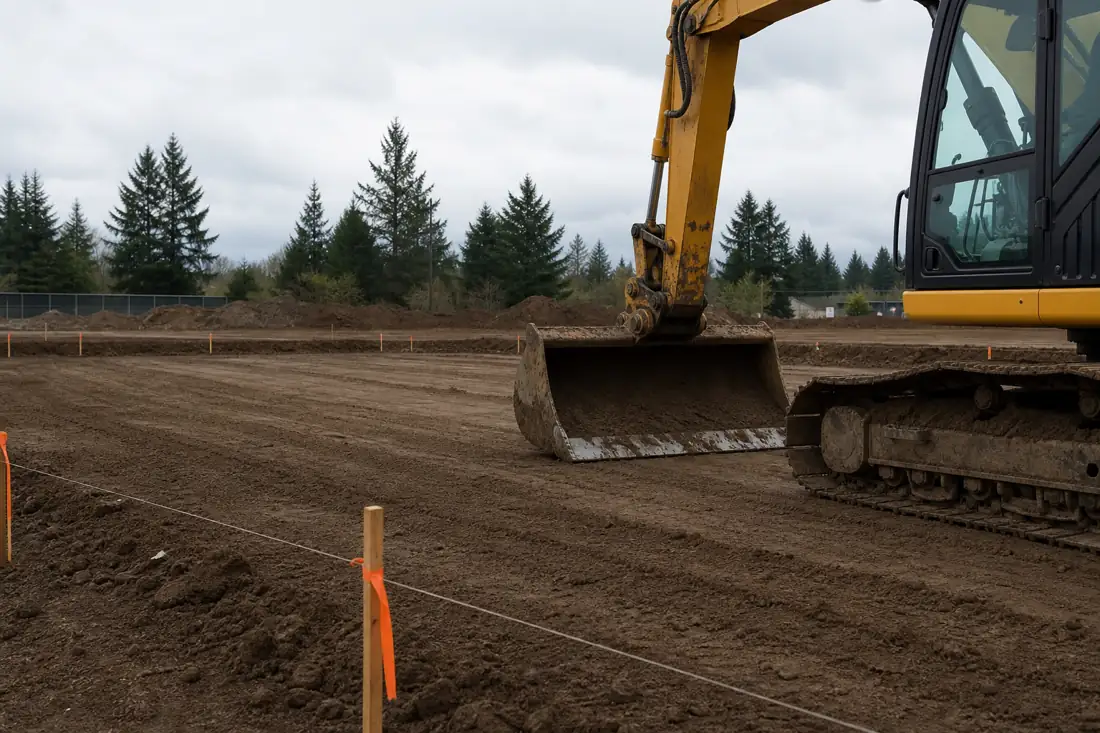
On rural parcels around Banks, grading means reading where water currently goes before the first cut, then building fall deliberately so it ends up where you intend.
When a property around Banks, OR needs a flat pad for a shop building, a stable surface for loaded truck turns, or a long-term fix for a low spot that floods every winter, the project is grading — and it starts before any dirt moves. Hillsboro Excavation Co. handles rural grading around Banks, a town of 1,837 people on 0.37 square miles where the typical grading job is not a subdivision lot but a working parcel that has to remain functional throughout the work. Getting that right requires reading the existing drainage patterns before touching the grade, then designing the new surface so water moves where the property owner intends it to go and does not find a new path to a place it should not be.
The Tualatin Valley soils west of Hillsboro are silty clay. That soil holds compaction well once properly worked and dried, but it becomes plastic and unstable when saturated. A grading project that starts on wet ground in November and gets half-finished creates a surface that sheds water unpredictably and erodes until the job is completed and the surface stabilized. Around Banks, the dry grading window runs roughly from June through September. Work outside that window is possible but requires careful attention to soil moisture and staged completion so that exposed surfaces do not erode between mobilizations. Clean Water Services erosion-control rules apply to disturbed sites in this area, and exposed silty clay in winter rain produces sediment-laden runoff that reaches drainage courses quickly.
Grading jobs on rural parcels near Banks fall into several recurring categories. Each has specific requirements for drainage, compaction depth, and spoil handling that differ from what a residential subdivision lot would need.
Each category requires a different approach to compaction depth and drainage routing, which is why the excavation contractors in Hillsboro, OR assess existing drainage patterns on the ground before proposing a grade design, rather than arriving with a predetermined plan.
Flat ground in the Tualatin Valley is rarely hydraulically flat. It has subtle high and low points, drainage paths worn into the surface over years of sheet flow, and underground tile or culverts that move water in ways invisible during a dry-weather site walk. Grading without understanding existing drainage creates problems: fill placed over a natural drainage path blocks flow and raises the water table upstream; a new pad cut into a slope without a perimeter swale collects runoff from above and holds it at the edge of the building. Before dirt moves on a Banks-area project, identifying where water currently goes — both on the surface and below it — is part of what allows the new grade to function correctly rather than simply moving a problem from one location to another.
Banks occupies 0.37 square miles with a compact street grid. On in-town lots, there is very little room to spread spoil material on-site, and local streets limit where loaded trucks can exit without creating road damage or access conflicts. On rural parcels outside town limits, spoil can sometimes be redistributed across the property if the additional elevation works for the owner’s longer-term plans, but significant volumes require off-site hauling to an approved fill site. The Hillsboro excavation team accounts for spoil volume and disposal in the project estimate because unexpected hauling cost is one of the most common ways a grading project runs over budget, particularly on rural ground where the cut volume is larger than it appears during a surface inspection.
Most residential and agricultural grading around Banks does not require a standalone grading permit, but the downstream project usually triggers a review that covers grading. A shop or outbuilding permit in Washington County includes site plan review with drainage requirements. Earthwork disturbing an acre or more requires a Clean Water Services erosion-control plan before work begins, and may trigger the Oregon DEQ 1200-C stormwater permit depending on discharge routing. County road connections require an access permit from Washington County Public Works. Confirming permit requirements before mobilizing prevents work stoppages and redesign costs that arrive mid-project when the excavator is already on site and the schedule cannot be easily adjusted.
Grading costs on rural parcels near Banks depend on cut volume, haul distance to a disposal site, and the actual condition of the subgrade. A small shop pad on firm, dry ground is a straightforward project at a predictable cost. A low-spot correction that requires removing saturated material and importing compacted structural fill to replace it costs substantially more because of the additional excavation, the material cost, and the compaction passes required between lifts. The Hillsboro excavation crew provides estimates based on observed site conditions from a site visit rather than a square-footage formula, because grading costs are driven more by what is in the ground than by how many square feet are on the surface.
Hillsboro Excavation Co. regrades rural parcels around Banks so water leaves the ground instead of sitting on it, one of the services offered by excavation contractors in Hillsboro, OR.
A haul route is built to carry traffic through or across a site temporarily; it is typically a single compacted layer over native soil and is not engineered for sustained repeated loading. A shop pad is built to carry a building load or regular heavy equipment use over years: it requires cutting to stable native subgrade, placing fill in compacted lifts, and grading the finished surface to drain on all sides. Using haul-route construction standards for a pad that will carry a building or heavy equipment results in settlement and drainage problems within a few seasons.
The first step is understanding why the low spot holds water — whether it is a natural drainage collection point, a compaction-induced depression, or an area where underground tile has failed. If the subgrade is saturated, placing fill on top without addressing the drainage will produce a soft spot that sinks under load and continues to collect water because the drainage path has not changed. The correct approach involves removing or stabilizing saturated material, restoring drainage to an outlet, and then placing fill in compacted lifts to raise the finished grade.
Standalone grading for a farm pad or access route often does not require its own permit, but the project triggering the grading usually does. A shop or outbuilding permit in Washington County includes site plan and drainage review. Earthwork disturbing an acre or more requires a Clean Water Services erosion-control plan and may require the Oregon DEQ 1200-C stormwater permit. Connections to county roads require an access management permit. Checking which permits apply before mobilizing prevents stop-work orders that arrive when the excavator is already on site.
Grading on wet silty clay requires careful management. Exposed silty clay in winter rain erodes quickly and produces sediment runoff. Work should be staged so exposed areas are either stabilized or covered at the end of each workday, and Clean Water Services erosion-control rules apply to most disturbed sites larger than a single residential lot. Scheduling grading during the June-through-September dry window reduces erosion risk, produces better compaction results, and avoids the cost of erosion controls required on wet-season projects. Smaller in-town jobs can be managed in the wet season with good staging.
Cost depends on the volume of material moved, the condition of the existing subgrade, and the haul distance for spoil. A small level pad on firm ground is a predictable project. A low-spot correction that requires removing saturated material and importing structural fill costs significantly more. Haul distance matters: spoil that can be spread on the same property costs less to manage than spoil that has to leave by truck to a disposal site. A site visit is the only way to arrive at an accurate number because the ground conditions visible at the surface rarely tell the full story.
June through September is the preferred window. During that period the silty clay soil is dry enough to compact properly, equipment can work without rutting the surface, and finished grades dry and stabilize before fall rains arrive. Work outside this window is manageable on smaller projects with attentive erosion control and staged completion, but wet-season grading produces less consistent compaction and may need additional passes after the ground dries to correct settlement that occurs as the soil loses moisture.
Tell us about your project and we will come walk the site and give you a straight, itemized quote — no obligation, no pressure. Call us, or send the form and we will get back to you the same business day.
Call or text and reach us directly. We answer during business hours and return every message.
(971) 397-9361Hours: Mon–Sat, 7am–6pm