Home › Forest Grove
Water against a foundation or pooling in a Forest Grove yard is a grade problem — we map where it should go before moving any soil so the fix holds.
Corrective grading on an established Forest Grove property is a different job from grading a vacant lot for new construction. The ground has already been shaped, planted, and built around, and water is now going somewhere it should not go — against a foundation, under a slab, or pooling in a yard that was not always a problem. The first thing Hillsboro Excavation Co. does on a corrective grading job is establish where the water is actually going and where it is supposed to go before any machine touches the ground. Moving dirt without that answer usually redirects the problem rather than solving it.
Forest Grove covers 5.74 square miles of land and has 0.14 square miles of surface water within its boundaries. The Tualatin Valley silty clay that underlies most of the area does not drain freely — it holds moisture, and on a flat or negatively sloped lot, it holds moisture against whatever structure sits at the low point. The town was platted in 1850, and many of the older properties here were graded before modern drainage standards were established, or were graded for structures that have since been added to in ways that changed how water moved across the lot. Grade problems on established properties in Forest Grove are common and they do not fix themselves.
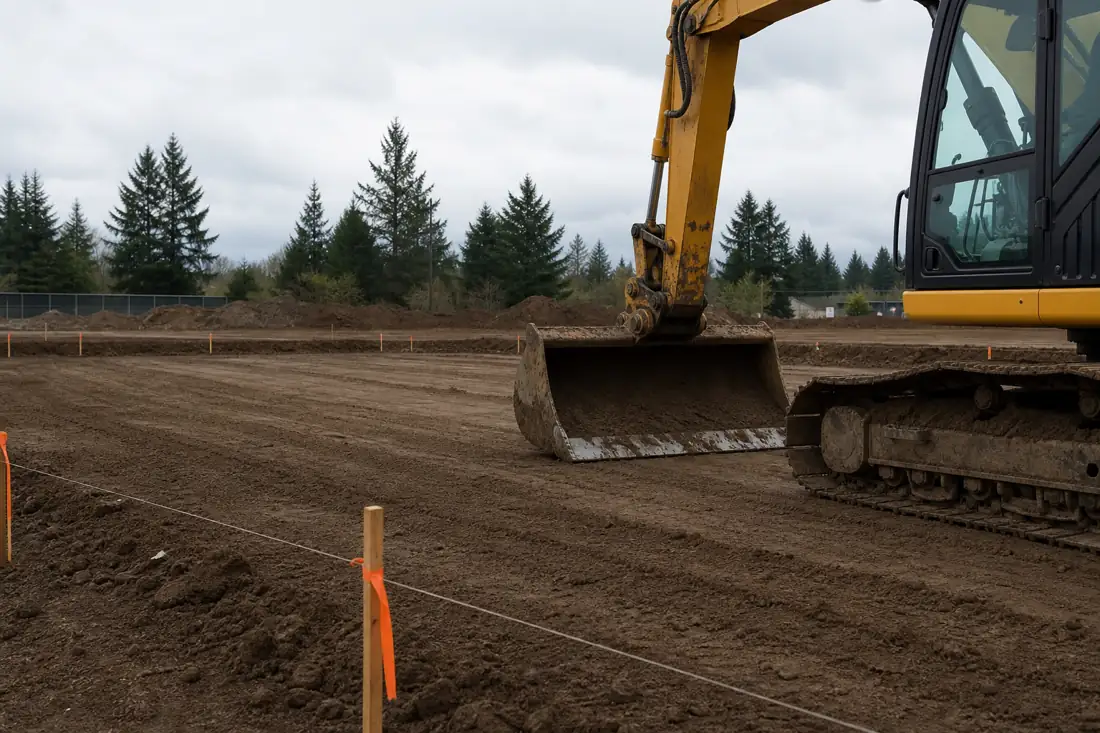
Regrading a property that has landscaping, hardscape, and a structure in place requires a different approach than a clean slate. Here is the sequence that produces a result that holds:
A property that drains correctly protects the foundation, the landscaping, and the hardscape from the damage that standing water causes over time. Our excavation contractors in Hillsboro, OR approach corrective grading as a drainage problem with a grading solution, not the reverse.
The most common thing homeowners try before calling a contractor is adding a load or two of topsoil to low spots in the yard. It is inexpensive, it raises the surface, and it looks like it should work. The problem is that raising a low spot without changing the surrounding grade usually creates a flat area where there was a depression, and flat ground does not drain. The topsoil compresses over the first wet season, settles back toward its original level, and the depression returns. Meanwhile, the topsoil added against the foundation has raised the soil level closer to the siding or the mudsill, which creates a new moisture pathway into the wall. The intent was to carry water away from the house; the result is a higher soil line touching the structure with nowhere for water to go. Regrading means removing material where the grade is too high, filling where it is too low, and establishing continuous fall across the surface so water has a direction to travel rather than a place to stop.
On an established Forest Grove property, the concrete driveway, the patio slab, the retaining walls, and the mature ornamental trees are frequently in exactly the locations that affect drainage the most. A driveway that was poured flat collects water against the garage. A patio that has settled toward the house directs water at the foundation rather than away from it. Mature trees cannot be root-pruned aggressively without losing them, so grade changes near tree drip lines have to be modest and carefully executed. Our Hillsboro excavation team documents the existing constraints on every corrective grading job before we design the new grade, because a plan that ignores what is already there will not survive first contact with the property.
Corrective grading on an existing residential property in Forest Grove typically does not require a grading permit if the disturbance is modest and does not involve retaining walls above a certain height. Washington County has specific thresholds for when grading permits are required, and we identify those early. Clean Water Services erosion-control requirements apply to any disturbed area regardless of permit status, so silt fencing, construction entrance, and re-seeding are part of every job. Downspout discharge is a separate but connected question — Oregon does not allow downspouts to discharge directly to the street in most situations, and the regraded surface has to integrate with wherever the downspout water is going, which may mean adding a dry well, a French drain, or an extension that runs to a vegetated area. We flag these intersections at the estimate stage so the project scope covers the full drainage path, not just the surface grade.
Corrective grading cost on an established Forest Grove property depends on how much material has to move, whether built-up topsoil has to be removed, how much new fill is needed, and how the job integrates with existing hardscape. It also depends on whether downspout drainage work is in scope. We scope corrective grading differently than new construction grading because the constraints are different: less machine room, more precision, and a finished product that has to look right as well as drain right. The Hillsboro excavation crew gives you a clear scope and a cost that reflects those constraints before we start, not after we encounter them.
Corrective grading on an established property requires precision around existing landscaping and hardscape. See the full range of services from excavation contractors in Hillsboro, OR.
If water is pooling in the yard away from any structure, a French drain or catch basin may be sufficient. If water is accumulating against the foundation, sitting against a slab edge, or showing up in a basement or crawl space after rain, the surface grade is likely part of the problem and regrading should be evaluated. We walk the property and look at both the surface fall and the downspout discharge locations before recommending a solution.
Grade changes within the drip line of a mature tree can damage roots and destabilize the tree if done aggressively. We map existing trees and design grade changes that stay well outside the critical root zone where possible. Where the grade change must occur near established plantings, we work in small increments rather than large cuts or fills, and we discuss the risk with you before we commit to a scope.
Because water is where the problem is. In dry conditions a low spot looks like low ground. In wet conditions you can see where water is moving, where it is stopping, and where it is accumulating against the structure. A site visit in dry weather tells us the topography; a site visit during or after rain tells us the drainage behavior. For corrective grading we want to see both.
In most cases yes, but the concrete constrains what grades are achievable. If a driveway was poured flat or sloping toward the garage, the grade around it can be raised to compensate, but the driveway surface itself will remain as it was. If the concrete is the primary source of the drainage problem, replacement or resurfacing may be the more complete answer. We tell you what is achievable within the existing hardscape before you commit to a scope.
Corrective regrading typically costs less than new construction grading because the disturbed area is smaller, but it costs more per cubic yard because the work requires more precision, more hand work around landscaping and hardscape, and more time to sequence around constraints. A simple yard regrade with minor topsoil redistribution is a half-day job; a full foundation perimeter regrade with downspout integration and hardscape coordination is a multi-day project. We scope it specifically to your property.
Minor residential regrading typically does not require a grading permit in Washington County, but Clean Water Services erosion-control requirements apply to any disturbed ground. If the project involves a retaining wall above a certain height, a separate permit is required. If the work redirects drainage to an adjacent property or to a street, that may trigger additional review. We identify the applicable requirements at the estimate stage so you are not surprised after work begins.
Tell us about your project and we will come walk the site and give you a straight, itemized quote — no obligation, no pressure. Call us, or send the form and we will get back to you the same business day.
Call or text and reach us directly. We answer during business hours and return every message.
(971) 397-9361Hours: Mon–Sat, 7am–6pm