Home › Cornelius
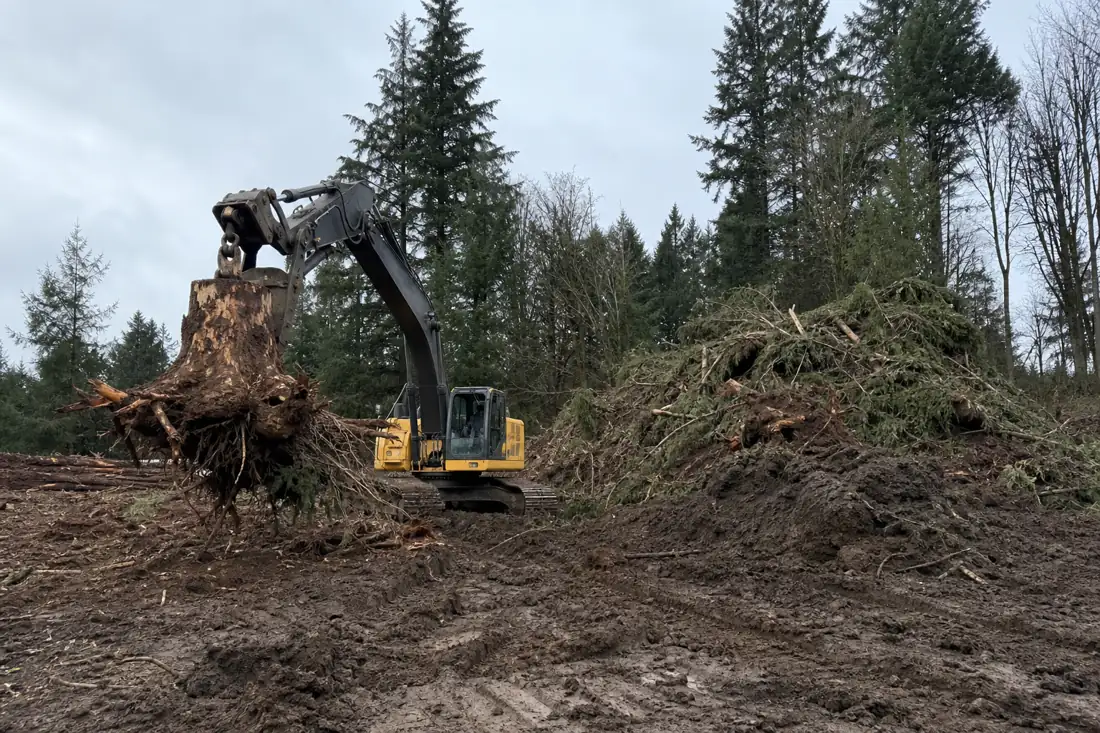
Clearing tight residential lots in Cornelius means working through narrow side yards, protecting fence lines, and hauling debris out through a neighborhood — not across open ground.
Land clearing in Cornelius, OR is rarely a wide-open demolition job. Cornelius covers just 2.340 square miles of land and holds 4,843 households — that density means most residential lots have a house already on them and neighbors within feet of every property line. Hillsboro Excavation Co. handles the full scope: brush removal, stump grinding, grubbing root systems, and hauling debris out, all while keeping the existing structure, fence lines, and adjoining properties intact. It’s methodical work on tight ground.
The physical constraint that shapes every Cornelius clearing job is access. Machines that would roll freely across an open parcel may not fit through a residential side yard. On many Cornelius lots the usable gate opening is six to eight feet, which dictates compact equipment rather than full-size machinery. Compact excavators and skid-steers can do the work but they move less material per pass, so haul-off happens in more loads and staging within the yard becomes part of the plan. Washington County’s silty-clay soils also track heavily when wet, meaning ground conditions through the October-to-May wet season add another layer of coordination.
Clearing a hemmed-in residential site in Cornelius requires breaking the job into smaller pieces than you would on open ground. Here is what that looks like in practice.
Every step above is a direct consequence of the lot geometry. On a Cornelius infill parcel there is no room to simply pile everything and deal with it later — which is why working with the excavation contractors in Hillsboro, OR who know these blocks matters. Planning access and debris flow upfront avoids the mid-job problem of a yard full of brush with no way to get it out.
Tualatin Valley silty clay compacts and seals under equipment traffic. On a large rural lot you can drive a different line each pass and let the disturbed surface recover between loads. On a Cornelius residential lot there is often one path from gate to work area, and every load from the first to the last travels over the same strip of ground. That strip turns to ruts if it is not managed. Running compact equipment keeps the ground pressure lower, and laying temporary track matting over the access path eliminates rut damage entirely. The cost of the mats is cheaper than repairing a torn-up side yard, and the neighbor relations are better too. Add the wet season — October through May in Washington County — and soil management becomes the central problem of the job rather than a secondary concern.
Cornelius was built out at a time when lot lines were tight and houses sit close to their neighbors. A clearing job on one lot is therefore a potential liability event for the lot next door if it is not managed. Root systems from mature trees can extend under the fence line; pulling a stump without accounting for what the roots are attached to can shift a fence post or crack a neighbor’s irrigation line. Our Hillsboro excavation crews hand-dig around anything close to a boundary before machine work begins there. It is slower, but the alternative is a repair bill that was entirely avoidable. On infill lots, the boundary is never just a line on paper — it is a live constraint that every pass of the machine has to respect.
Pricing on Cornelius clearing jobs is driven by access, not by acreage. A 5,000-square-foot lot cleared with a compact machine through a narrow gate can cost more than a 10,000-square-foot lot on a corner with open access, because the gate job requires more setups, smaller loads, and extra handling time at every stage. Before we quote any Cornelius job we look at the access width, the surface between street and work area, and how the debris will leave the site. Those three factors set the labour component more than the volume of material does. If basalt is close to the surface, that changes the equipment and the timeline; in parts of Washington County it appears within a few feet of grade.
On the permit side, a clearing project in Cornelius that disturbs an acre or more requires an Oregon DEQ 1200-C stormwater permit and compliance with Clean Water Services erosion-control rules. Most residential infill lots fall well under an acre, but any grading that follows the clearing may push the cumulative disturbed area over the threshold. The Hillsboro excavation crew can help you work out whether a permit is required before work begins rather than after a stop-work notice arrives. Call 811 is required before any digging regardless of permit status — utility locate on a tight residential lot is not optional.
Land clearing in Cornelius runs differently from open-site work: ask the excavation contractors in Hillsboro, OR who know what compact equipment and staged haul-off actually take.
Yes, but the machine choice depends on the opening. We measure the gate, the clearance overhead, and the ground condition of the access path before scheduling. If a full-size excavator does not fit, we use a compact tracked machine or skid-steer instead. Compact equipment moves less per pass but fits where larger machines cannot, and that is often the only viable option on Cornelius infill lots.
We flag boundary lines and any structures within machine reach before work starts. On lots where the fence is shared or close to the work area, we hand-dig around roots near the fence line rather than pulling stumps blind with the machine. That adds time but prevents fence damage, shifted posts, and the neighbor relations problems that come with them. We document site conditions before we start.
Debris leaves through the same access it came in through, which on a tight lot means staged loads rather than one big haul. Brush, stumps, and root material are sorted as we go so the load can be sized to the route. We haul it off-site. If you have a specific disposal requirement — for example, a burn pile is not an option in the city — we account for that in the quote and the schedule.
Both methods have a place depending on what is going over the stump afterward. Grinding leaves the root plate in the ground and works when you are seeding grass. Pulling removes the root mass entirely and is usually the right call when a foundation, slab, or paved surface is going in, because a rotting root plate will eventually create a void. On Cornelius lots we pull roots close to structures where the decomposition gap would matter.
Access is the main cost driver, not square footage. Moving the same volume of material through a six-foot gate costs more than moving it across open ground, because the machine is smaller, the load sizes are constrained, and the operator handles each piece more often. We price after looking at the access, not from an aerial photo. Jobs where the lot is tight but the access is clean quote differently than jobs where both are constrained.
A DEQ 1200-C stormwater permit is required for projects disturbing an acre or more of ground — most single-family lots in Cornelius are well under that. Clean Water Services erosion-control rules still apply regardless of size if you are working near a drainage channel. Call 811 for utility locates before any grubbing or digging begins. If grading follows the clearing, the combined disturbed area may cross the permit threshold; check before you start, not after.
Tell us about your project and we will come walk the site and give you a straight, itemized quote — no obligation, no pressure. Call us, or send the form and we will get back to you the same business day.
Call or text and reach us directly. We answer during business hours and return every message.
(971) 397-9361Hours: Mon–Sat, 7am–6pm