Serving Hillsboro & all of Washington County, OR Free estimates: (971) 397-9361
Hillsboro Excavation Co.

Home › Forest Grove

Septic System Installation in Forest Grove, OR

Forest Grove’s oldest systems were installed before today’s setback rules existed — replacement means designing for current standards, which often means the new field cannot go where the old one was.

Licensed & insured in Oregon Free on-site estimates Local Washington County crew Wet-season ready

When a septic system fails in Forest Grove, the work is not simply a matter of removing what is there and putting in the same thing. Many systems in Forest Grove were installed under rules that have since been substantially revised: setbacks from surface water were smaller, drainfield siting criteria were less stringent, and engineered alternatives that are now commonplace did not exist. Replacing a system means designing the replacement for today’s standards, which often means it cannot go where the original was located. Hillsboro Excavation Co. handles the excavation for both removal and replacement, and the first task is understanding what failed and why.

Forest Grove covers 5.88 square miles in total, with 5.74 square miles of land and 0.14 square miles of surface water. The town was platted in 1850, which means the oldest parcels here are more than 170 years old and may have had multiple septic systems installed over the decades, each built to the rules in place at the time. Systems installed near streams or drainage ditches that predate today’s water-setback requirements are particularly common, and they are also the systems most likely to face siting constraints on replacement.

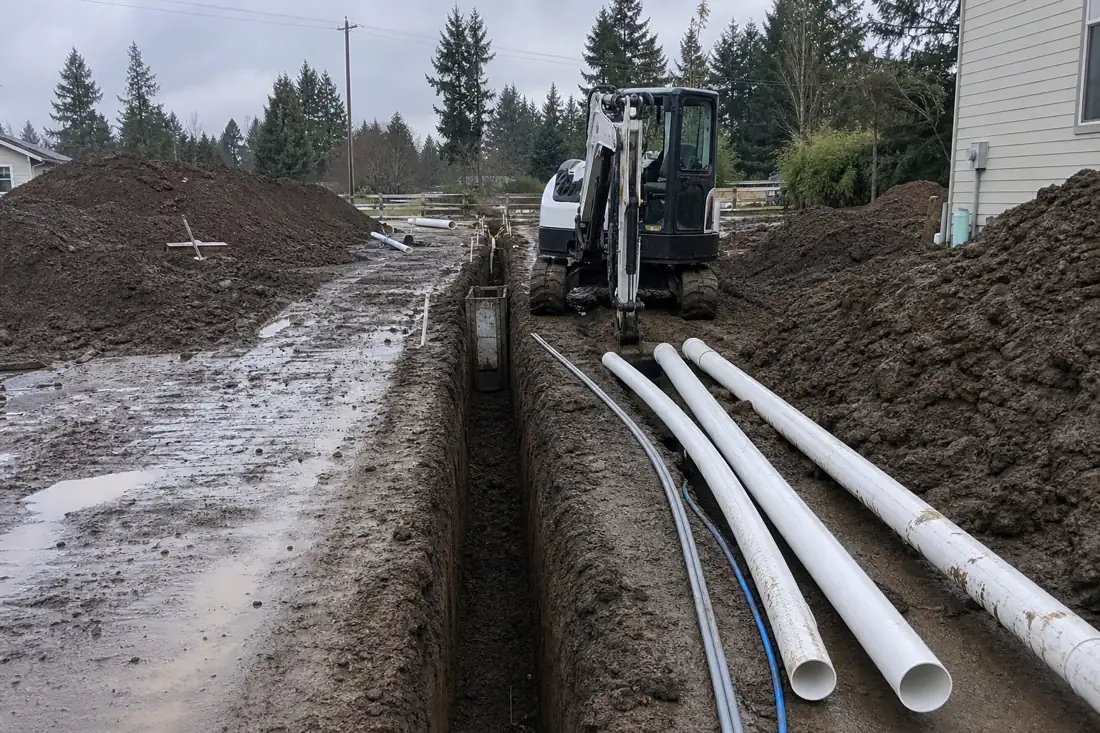
Excavation crew exposing old septic system components during replacement work in Forest Grove OR
Replacement work begins with exposing and evaluating the existing system to determine what has failed before designing what replaces it.

Diagnosing Tank Failure Versus Drainfield Failure

Before excavation begins on a replacement, it is necessary to identify which component of the existing system has failed. The answer changes what gets replaced and where, and determines the scope of the excavation work. Tank failure and drainfield failure produce similar symptoms at the surface but have different causes and different fixes.

Accurate diagnosis before excavation saves the cost of replacing components that are still functional. It also establishes the system history that Washington County Environmental Health needs to review when issuing the replacement permit. Working with excavation contractors in Hillsboro, OR who understand the permit process means the site evaluation and design work happens in the right sequence before the first machine mobilizes.

Why the Replacement Cannot Go Where the Old System Was

The most common misconception in septic replacement is that the new system goes in the same location as the old one. In Forest Grove, that is frequently impossible. Washington County’s current setback rules require a drainfield to be located a minimum of one hundred feet from any surface water, including streams, drainage ditches, and ponds. Systems installed in the 1950s through 1980s were sometimes sited much closer than one hundred feet to whatever water feature was present — or may have been sited before the water feature was mapped at all. When the current rules are applied to the parcel, the original field location may fall within an exclusion zone. Beyond the water-setback issue, soil that has hosted a drainfield for decades is typically saturated with biomat — the biological layer that forms when fine particles and microbial growth reduce soil permeability over time. Even if the location were otherwise legal, the same soil cannot successfully host a replacement field without years of rest and recovery. A new site evaluation is required for every replacement permit to establish where a system can be located under current standards.

Decommissioning the Old Tank Properly

Oregon DEQ and Washington County require that an abandoned septic tank be decommissioned before or immediately after the replacement system is operational. Decommissioning means the old tank cannot remain as an undocumented void in the ground. The standard process requires the tank to be pumped out completely, any inlet and outlet piping to be disconnected and capped, and the tank shell itself to be either filled with concrete slurry or crushed in place and backfilled with soil. A tank that is simply abandoned without filling presents a collapse hazard and a potential groundwater contamination pathway. The decommissioning work is documented on the replacement permit, and Washington County’s inspector verifies that it was done before issuing final sign-off. The Hillsboro excavation crew handles the excavation access needed to expose an old tank for decommissioning, which sometimes involves digging through established landscaping or driveways to reach a tank that was buried without a surface marker.

Permits and Costs for Septic Replacement in Forest Grove

A replacement septic system in Forest Grove requires the same Washington County Environmental Health permit process as a new installation, with one additional requirement: the existing system must be properly decommissioned as part of the permitted scope. The county requires a new site evaluation because the original evaluation, which may have been conducted under rules that no longer apply, cannot be relied upon to identify a compliant location for the replacement field. Plan review follows site evaluation, and the permit fee schedule reflects the complexity of the system design. Replacement systems near Forest Grove’s 0.14 square miles of surface water are more likely to require alternative designs — mounded systems, pressure-dosed laterals, or sand filters — because the replacement field must meet current water-setback requirements even if the original system did not.

The excavation cost of a septic replacement is typically higher than a new installation on an undisturbed parcel because the crew must first remove or work around the old system components. Exposing and decommissioning a buried concrete tank requires excavation, and if the tank is under a driveway or an addition added after the original install, that surface must be opened. The old drainfield piping and gravel must be removed or isolated from the new system to prevent cross-connection. If the replacement field must be located in an area of the property that was not previously disturbed, establishing equipment access across established landscaping or finished yard adds to the mobilization scope. The Hillsboro excavation crew reviews the replacement permit and the parcel layout before estimating, because the access and removal requirements vary significantly from one Forest Grove property to the next.

Excavation Services We Provide in Forest Grove

Replacing an aging septic system in Forest Grove requires both demolition and new installation — work with the excavation contractors in Hillsboro, OR who understand the full permitted scope.

Drainage & French Drains

Drainage & French Drains →

Site Preparation

Site Preparation →

Utility Trenching

Utility Trenching →

Grading & Leveling

Grading & Leveling →

Frequently Asked Questions

How do I know if my septic tank has failed or if the drainfield has failed?

Tank failure and field failure look similar at the surface but have different causes. A tank inspection — opening the lids and measuring liquid levels with an intact baffle check — rules out the tank as the primary failure point. If the tank is operating correctly and liquid is still surfacing at the field or fixtures are draining slowly, the drainfield has typically failed through biomat accumulation. A probe test at field depth confirms whether the soil can still absorb liquid or has sealed.

Can the replacement drainfield go in the same place as the old one?

Rarely. Soil that has hosted a drainfield for many years typically has a biological seal (biomat) that prevents it from absorbing liquid again without years of rest. More critically, current Washington County setback rules may prohibit the original location entirely — especially near surface water. Forest Grove has 0.14 square miles of surface water, and many older systems were sited before the current 100-foot water setback was in effect. A new site evaluation determines where a replacement field can be legally located.

What does decommissioning an old septic tank require?

Washington County requires abandoned tanks to be pumped out, all piping disconnected and capped, and the tank shell filled with concrete slurry or crushed in place and backfilled. The requirement exists because an abandoned tank creates a subsurface collapse hazard over time and can be a groundwater contamination pathway if any waste residue remains. Decommissioning is documented on the replacement permit and verified by a county inspector before the permit is closed out.

Does proximity to a stream or pond affect where the new field can go?

Yes, significantly. Washington County requires a drainfield to be at least one hundred feet from any surface water, including streams, drainage ditches, seasonal channels, and ponds. In Forest Grove, where 0.14 square miles of the city is surface water, many parcels have water features within that radius. The required separation must be measured to the field boundary, not the center of the field, which tightens the available envelope further. Systems that cannot meet the setback with a conventional field must use alternative designs.

What does septic replacement cost in Forest Grove compared to a new install?

Replacement typically costs more than a new install on undisturbed ground because the crew must remove or work around existing system components. Decommissioning and removing the old tank, pulling old drainfield pipe and gravel, and establishing machine access around an existing house all add to the scope. If the replacement field must go in a location that was previously finished yard or landscaping, that surface must be opened, graded, and restored. The exact cost depends on what the approved replacement plan specifies.

How long does the replacement permit process take in Washington County?

The timeline depends on how quickly a site evaluation appointment is available and how long plan review takes. Site evaluations are best conducted during the wet season when groundwater conditions are at their seasonal high — the time when a marginal site is most likely to fail the evaluation and when an adequate site is confirmed under worst-case conditions. Plan review typically takes two to four weeks after a complete application is submitted. Starting the process before the system reaches a point of emergency avoids pressure to cut corners on the design.
Get Your Free Hillsboro Excavation Estimate

Tell us about your project and we will come walk the site and give you a straight, itemized quote — no obligation, no pressure. Call us, or send the form and we will get back to you the same business day.

We only use your info to contact you about your project. No spam, ever.

Prefer to talk?

Call or text and reach us directly. We answer during business hours and return every message.

(971) 397-9361

Hours: Mon–Sat, 7am–6pm