Serving Hillsboro & all of Washington County, OR Free estimates: (971) 397-9361
Hillsboro Excavation Co.

Home › Gaston

Septic System Installation in Gaston, OR

Gaston’s position on the Tualatin River means the seasonal high water table — measured in February, not August — is the constraint that governs every septic design on river-adjacent parcels.

Licensed & insured in Oregon Free on-site estimates Local Washington County crew Wet-season ready

A drainfield disperses treated effluent into the soil below the trench bottom. For that process to work, there must be an adequate vertical distance between the trench bottom and the top of the seasonal high water table: if saturated groundwater reaches the trench bottom, the soil cannot absorb downward and the system backs up. In Gaston, where 676 people live on 0.28 square miles of land bordering the Tualatin River, the seasonal high water table is exactly the constraint that governs every septic design. Hillsboro Excavation Co. does the excavation for septic installations in river-adjacent communities like Gaston, and the conversation always begins with how much vertical separation actually exists at the proposed field location.

Gaston straddles Oregon Route 47 between Forest Grove and Yamhill, and the town’s eastern edge borders the Tualatin River. The river is not just a geographic boundary — it sets the regional groundwater elevation across the low-lying parcels near the bank. During the October-to-May wet season, groundwater across Tualatin Valley rises substantially from wet-season precipitation. In river-adjacent parcels, that rise can be extreme, and a field that appears to have adequate vertical separation in August may be submerged in February.
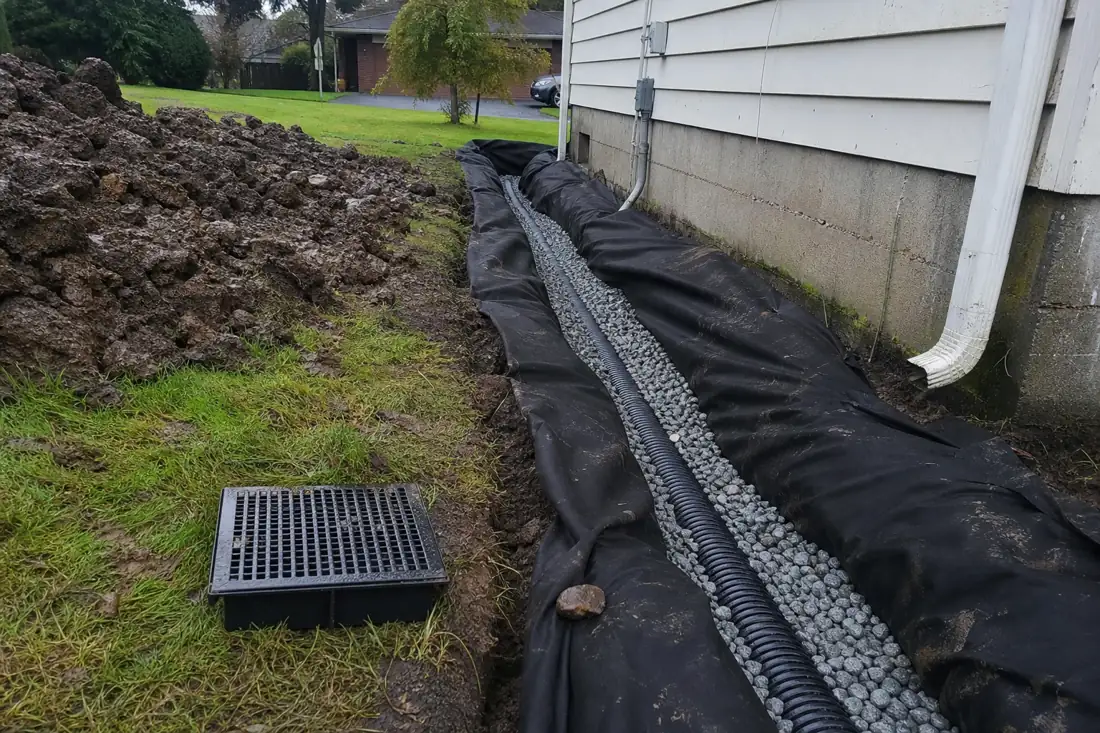
Drainage excavation work in Gaston OR near Tualatin River for septic installation site preparation
Managing groundwater and surface drainage is a prerequisite for septic system work in river-adjacent Gaston, where seasonal water table elevation governs both system design and erosion risk.

Why Winter Groundwater — Not Summer — Is the Design Standard

Oregon DEQ and Washington County require that the seasonal high water table elevation — the highest level groundwater reaches during the year — be used as the governing constraint for drainfield design. This is not the water table level measured in August after a warm-summer Mediterranean dry season has drawn groundwater down; it is the level measured during peak wet-season saturation, which in the Tualatin Valley typically occurs between January and March. Here is what that means in practice on a river-adjacent parcel.

These are not theoretical design considerations; they are the practical engineering responses to conditions that exist on specific Gaston parcels right now. Excavation contractors in Hillsboro, OR who have excavated both conventional and mounded systems understand what each design requires in the field and can execute the approved plan accurately once site evaluation and permit review are complete.

When a System That Passes in August Fails in February

The scenario that damages Gaston septic systems most predictably is a system designed or evaluated under summer conditions that encounters winter groundwater levels it was not sized for. A homeowner who notices slow drains or wet spots over the drainfield in January or February is experiencing a real and common pattern: the field was adequate when the water table was low, and it is now inadequate because the water table has risen to or above the trench bottom. The effluent has nowhere to go downward, so it backs up into the distribution pipes and surfaces. This is not simply a system in need of maintenance — it is a system that was installed with insufficient vertical separation for the site’s actual seasonal groundwater conditions. The repair is a redesign, not a cleanout. A mounded system or a sand-filter alternative is the engineering response, and both require the same permit process as an original installation.

Mounded Systems and Sand Filters: How Separation Is Restored

A mounded drainfield raises the field above the seasonal high water table by constructing a sand bed on top of the native soil surface. The effluent from the house moves through the tank, then is distributed into the elevated sand bed through a pressure-dosed distribution system. Gravity is not adequate to move effluent uphill into a mound, so a pump chamber and a dosing pump are required between the tank and the field — which adds an electrical component and an ongoing maintenance requirement that conventional systems do not have. The mound must be large enough in footprint to provide the required absorption area and must be set back from all property lines and structures, which means mounds take up more ground than the equivalent conventional field. On Gaston’s small 0.28-square-mile footprint, parcel sizes are tight, and the additional footprint of a mound is a real design constraint. Where a mound will not fit, a sand filter provides pre-treatment that elevates effluent quality to a level that allows a reduced final field area, which can fit within a smaller envelope. Both systems require the same Washington County Environmental Health permit process as any other installation. The Hillsboro excavation crew handles the earthwork for mound construction and sand-filter bed excavation alongside conventional field work.

Erosion Control, Permits, and Costs for Septic Work in Gaston

Gaston’s proximity to the Tualatin River makes erosion control a non-negotiable requirement for any excavation work, not an optional add-on. Clean Water Services, the regional utility that manages water quality in the Tualatin watershed, enforces erosion and sediment control requirements that apply to any ground disturbance near a waterway. Sediment from excavation work that reaches the river carries phosphorus and fine particles that degrade water quality and affect aquatic habitat. Silt fence, straw wattles, stabilized construction entrances, and daily inspection of control measures are standard requirements, and they remain in place until disturbed soil is stabilized by vegetation or hardscape. Violating these requirements carries fines and can result in a stop-work order that halts the entire septic installation. The Oregon DEQ 1200-C stormwater permit applies to projects disturbing an acre or more of ground, and even smaller projects must comply with Clean Water Services’ local requirements.

The permit process for a Gaston septic installation follows Washington County Environmental Health procedures, with the site evaluation scheduled during the wet season when seasonal high groundwater conditions are observable. For parcels where mounded or alternative systems are required, plan review is more detailed and permit fees are higher than for a conventional gravity system. The excavation cost reflects the additional earthwork required for a mound — importing clean sand, constructing the mound profile, and grading the surface to drain away from the field — compared to simply digging trenches into native soil. River-adjacent parcels may also require dewatering of the excavation during the wet season if groundwater intersects the trench depth during construction. The Hillsboro excavation crew accounts for dewatering, erosion control installation, and the specific earthwork scope of a mounded or alternative system when estimating work in Gaston.

Excavation Services We Provide in Gaston

Septic installation next to the Tualatin River requires groundwater analysis and erosion control that most rural projects skip — the excavation contractors in Hillsboro, OR handle both as part of the standard scope.

Drainage & French Drains

Drainage & French Drains →

Site Preparation

Site Preparation →

Utility Trenching

Utility Trenching →

Grading & Leveling

Grading & Leveling →

Frequently Asked Questions

Why does the seasonal high water table matter more than the summer water table for my Gaston property?

Oregon DEQ requires drainfield designs to be based on the seasonal high water table — the highest elevation groundwater reaches during the year — not on summer conditions when the water table is at its lowest after months without rain. A field with two feet of separation in August may have zero separation in February. The design must work under worst-case winter conditions, which is why site evaluations near the Tualatin River must be conducted during the wet season to observe actual peak groundwater.

How much vertical separation does a drainfield need from the water table?

Oregon DEQ requires a minimum of two feet of unsaturated soil between the bottom of a conventional drainfield trench and the measured seasonal high water table elevation. That two feet of separation provides enough distance for the soil to treat effluent before it reaches the groundwater zone. If that separation does not exist at native grade, a mounded system raises the field above the water table artificially, or a sand-filter system pre-treats effluent to a higher standard before it enters a shallower field.

What is a mounded septic system and when is one required in Gaston?

A mounded system constructs a drainfield above the native ground surface using a sand bed, raising the field elevation until the required two feet of separation from the seasonal high water table is achieved. It is required when native soil does not provide adequate separation at any achievable trench depth. Because effluent cannot flow uphill by gravity, mounded systems include a pump chamber that doses effluent into the elevated field. The mound requires more surface area than a conventional field and must meet the same setbacks.

Can sediment from a septic excavation reach the Tualatin River?

Yes, and it is the responsibility of the contractor and property owner to prevent it. Clean Water Services enforces erosion and sediment control requirements for any ground disturbance in the Tualatin watershed. Silt fence, sediment barriers, and stabilized access points are required and must be inspected daily. Sediment reaching the river carries phosphorus from soil particles that degrades water quality and affects aquatic life. Violations can result in fines and stop-work orders. Erosion control installation is part of the excavation scope, not an afterthought.

What does septic system installation cost in Gaston?

The cost depends on which system type the site evaluation supports. A conventional gravity system, if the parcel has adequate separation, costs less than a mounded or alternative system. Mounded systems require importing clean sand, constructing the mound profile, and installing a pump chamber and controls. Sand-filter systems add a pre-treatment bed to the scope. River-adjacent excavation may require dewatering during wet-season construction. All of these variables are known once the county-approved plan is in hand, and that plan drives the excavation estimate.

When should I schedule a site evaluation for a Gaston septic system?

The site evaluation should be scheduled between November and March when groundwater in the Tualatin River corridor is at or near its seasonal peak. Evaluations conducted in summer miss the high-water conditions that govern the design, and a system permitted based on a summer evaluation may be undersized for winter reality. Washington County Environmental Health conducts evaluations year-round, but for river-adjacent properties the wet-season window is when the evaluation produces a reliable design basis.

Get Your Free Hillsboro Excavation Estimate

Tell us about your project and we will come walk the site and give you a straight, itemized quote — no obligation, no pressure. Call us, or send the form and we will get back to you the same business day.

We only use your info to contact you about your project. No spam, ever.

Prefer to talk?

Call or text and reach us directly. We answer during business hours and return every message.

(971) 397-9361

Hours: Mon–Sat, 7am–6pm