Serving Hillsboro & all of Washington County, OR Free estimates: (971) 397-9361
Hillsboro Excavation Co.

Home › Banks

Site Preparation in Banks, OR

Most site prep near Banks starts on land that has been farmed—where the plow layer at the surface is not structural and the pad has to be built from stable subgrade up.

Licensed & insured in Oregon Free on-site estimates Local Washington County crew Wet-season ready

Site preparation on land around Banks, Oregon usually means working on ground that has been farmed. Farmed ground behaves differently from forest clearing or never-worked land, and that difference determines whether a building pad will hold or settle. The plow layer—the top twelve to eighteen inches that have been tilled, amended, and worked for decades—is loose, organic, and compressible. It looks like it might be adequate material at the surface, but it is not structural. A concrete slab or a pole barn bearing on that layer will move as the material consolidates under load and through wet seasons. Hillsboro Excavation Co. removes that layer as a first step, not an optional one, because the pad has to be built on something that will actually hold.

Banks sits in the northwestern Tualatin Valley with a population of 1,837 and a median age of 32.0. Roughly 30.6 percent of residents are under 18 and only 6.6 percent are 65 or older, which is a demographic profile that reflects a lot of young families. Much of the site prep work in this area involves family homes and shops going up on family land—a parent’s farm parcel being split off for a son or daughter to build on. That context matters for how a project is estimated and explained, because the people making the decisions are often first-time builders who need a clear account of what the ground requires and why, not a sales process that obscures the scope.

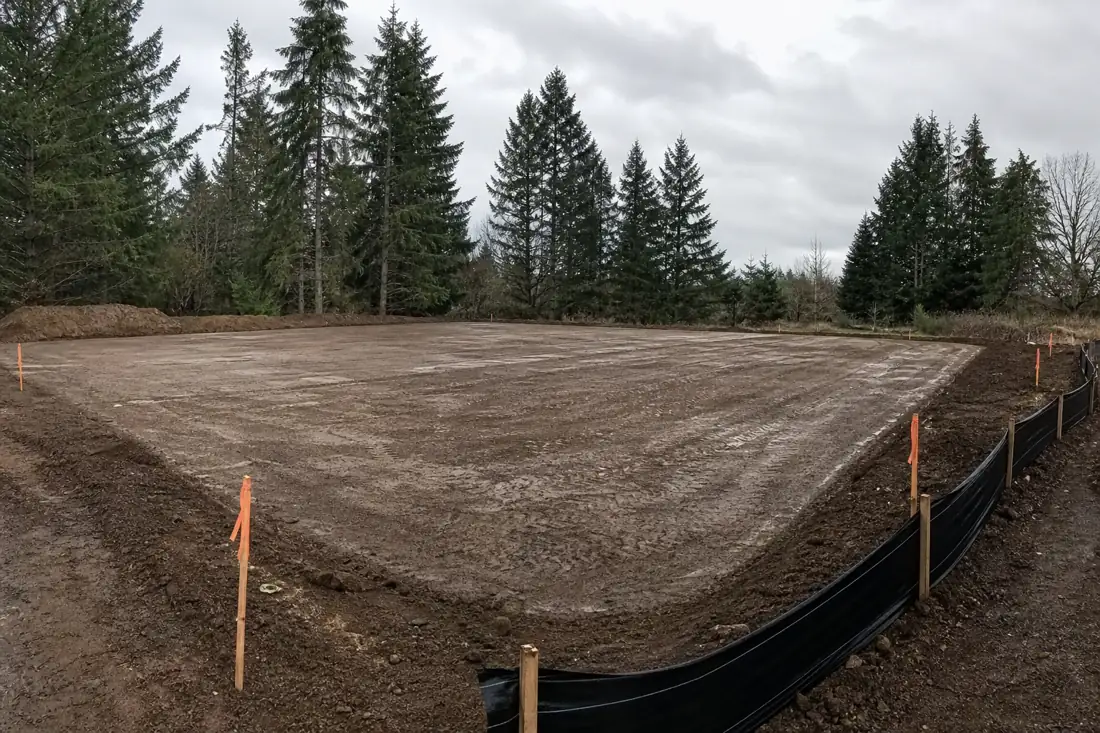
Excavator stripping topsoil on a farm parcel near Banks, Oregon, preparing the ground for a building pad
Stripping the plow layer exposes the subgrade condition—what looks like firm ground at the surface may be loose fill, and what is needed for a pad is stable, compactable material below it.

What Site Preparation on Banks Farm Ground Involves

Site prep on a farmed parcel around Banks is not the same job as clearing a wooded lot or grading a subdivision pad that has never been disturbed. Each step is shaped by the agricultural history of the ground and the soil profile that history has created.

Every one of these steps is a mechanical necessity, not an optional service tier. Excavation contractors in Hillsboro, OR who have worked on Washington County farm parcels know that what looks simple on flat open ground can reveal a complicated subgrade profile the moment the topsoil comes off.

How Farmed Ground Around Banks Differs From Other Site Types

Tualatin Valley silty clay is the dominant soil type across this part of Washington County, and under the plow layer it typically alternates between moderately compacted and very compacted zones depending on equipment traffic history, tile drain placement, and how long a particular area has been in production. That variability means a pad that crosses a former fence line, an old drainage ditch that was filled in, or a section of field that was used differently from the surrounding area can show dramatically different bearing capacity within a few feet. A flat surface and a uniform appearance at the topsoil level do not indicate a uniform subgrade. The only way to know what is there is to strip and look.

Over-Excavation Is Not an Upsell

The phrase “over-excavation” can sound like a contractor going deeper than necessary to run up material and machine hours. In the context of building pads on farm ground, it is the opposite: it is cutting until the subgrade is actually capable of supporting the load, rather than stopping at an arbitrary depth and hoping the material consolidates acceptably over time. The Tualatin Valley silty clay compacts well when it is at the right moisture content and placed correctly, but soft zones that have been disturbed by old drain tile removal or wet-season saturation do not self-correct under structural load. The decision to go deeper happens when the machine operator sees material that deflects, not on a schedule. Our Hillsboro excavation crews make that call transparently and document the depth so the client understands what was found and why the cut went where it did.

Timing, Cost, and What to Expect on a Banks Farm Parcel

Starting site prep between October and May on Tualatin Valley silty clay is almost always more expensive than waiting for dry-season conditions. Wet clay does not compact properly—the particles cannot move into a dense, stable arrangement when they are saturated, so lifts that would pass a compaction test in July may need to be dug out and redone in January. Equipment operating in saturated clay also causes subgrade disturbance that has to be corrected before fill can be placed. If the project schedule is flexible, a June start on this ground produces better results at lower cost than an October start. If the schedule is fixed and the pad needs to go in during the wet season, the estimate has to account for additional subgrade stabilization work and a longer compaction window between lifts.

For the families building homes or shops on land they already own outside Banks, the most useful thing a site prep contractor can do is give a straight account of what the ground requires and what that costs before any equipment moves. Young families building on a parent’s farm parcel are usually working within a defined budget that does not have a large contingency. The Hillsboro excavation crew quotes over-excavation as a conditional line item based on what the subgrade shows rather than padding the base number and absorbing the unknown, so the client knows what triggers additional cost and what it will be if it does. That honesty at the estimate stage is more useful than a low number that turns into a change order after the topsoil is already off.

Excavation Services We Provide in Banks

Building on farm ground around Banks takes a different approach than clearing bare land—contact the excavation contractors in Hillsboro, OR who understand what farmed soil requires.

Drainage & French Drains

Drainage & French Drains →

Site Preparation

Site Preparation →

Utility Trenching

Utility Trenching →

Grading & Leveling

Grading & Leveling →

Frequently Asked Questions

Does Hillsboro Excavation handle site prep on former farmland near Banks?

Yes. Most of the site prep work we do in the Banks area is on agricultural land—parcels that have been farmed and are being converted to residential or light commercial use. Farmed ground has a distinctive soil profile that requires stripping the plow layer, inspecting the subgrade, and building from stable material up. We quote each of those steps as separate, itemized work so the scope is clear before the equipment arrives.

Why does farmland require more over-excavation than other ground types?

Farmed soil has a plow layer of loose, amended topsoil over a subsoil that has been compacted by equipment and changed by drainage work over many years. That subsoil is not uniform—old drain tile beds, filled-in ditches, and transition zones between field sections can have dramatically different bearing capacity within a few feet of each other. Over-excavation goes to the depth where consistent, stable material begins, and that depth depends on what the ground shows, not a fixed number from a table.

What happens to the topsoil stripped during site prep near Banks?

We stockpile it on-site rather than hauling it off. Topsoil that has been under agricultural production for decades has good organic content and is useful as finish grade material around the completed structure for landscaping, lawn establishment, or garden areas. Trucking it off and then buying topsoil to replace it later costs money twice. If the site geometry makes on-site stockpiling impractical, we can haul it, but the default is to treat it as an asset and keep it available.

How do you confirm the subgrade is stable before placing structural fill?

Visual and physical inspection after stripping tells us a lot—material that deflects under the machine bucket or stays soft after a dry period is not adequate bearing material regardless of how it looks. Compaction testing with a nuclear density gauge or a Proctor test gives a measured number to compare against the specification. That test happens before concrete or any structural element goes on the pad, and it is what a building inspector or lender will typically require if the project involves a permit or financing.

What does site preparation cost on a Banks, OR farm parcel?

The main variables are pad size, depth to stable subgrade, the volume of structural fill needed to replace over-excavated material, and whether wet-season conditions require additional stabilization work before fill can be placed. Farm parcels around Banks often have more subgrade variability than urban lots, which is why we quote over-excavation as a conditional line tied to what the ground shows rather than folding an unknown into the base number. A dry-season start typically costs less than the same job begun between October and May because compaction is faster and subgrade disturbance is lower.

Is there a better time of year to start site preparation near Banks?

June through September is the best window on Tualatin Valley silty clay. Dry-season soil at the right moisture content compacts in fewer passes, structural fill lifts can be placed and tested on the same day, and the finished pad does not sit through a wet season before concrete goes on it. An October through May start is feasible but more expensive: saturated clay does not compact correctly, subgrade disturbance from equipment in wet conditions has to be corrected before fill is placed, and the compaction window between lifts is longer. We can work year-round; the cost difference is real and we explain it during the estimate.
Get Your Free Hillsboro Excavation Estimate

Tell us about your project and we will come walk the site and give you a straight, itemized quote — no obligation, no pressure. Call us, or send the form and we will get back to you the same business day.

We only use your info to contact you about your project. No spam, ever.

Prefer to talk?

Call or text and reach us directly. We answer during business hours and return every message.

(971) 397-9361

Hours: Mon–Sat, 7am–6pm