Serving Hillsboro & all of Washington County, OR Free estimates: (971) 397-9361
Hillsboro Excavation Co.

Home › Forest Grove

Site Preparation in Forest Grove, OR

Parcels platted since 1850 often hide old fill, buried debris, and buried structures — we open the ground first, investigate, then build a pad you can count on.

Licensed & insured in Oregon Free on-site estimates Local Washington County crew Wet-season ready

When you break ground in Forest Grove, you are rarely starting with untouched earth. The town was platted in 1850, and generations of structures, utilities, and fill have been added, removed, and forgotten since then. Hillsboro Excavation Co. approaches site preparation here differently than on a raw greenfield: we expose what is actually in the ground before we design the pad, because the ground itself decides what the project requires. Assuming the ground is suitable costs far more to correct after concrete is poured than before it is ordered.

Forest Grove covers 5.88 square miles, of which 0.14 square miles is surface water. That ratio means groundwater is not a remote concern on many parcels — it is a near-surface reality, especially during the October through May wet season when the Tualatin Valley water table rises. Old fill placed decades ago was not engineered for structural bearing, and a high water table can keep that fill saturated. A saturated, uncompacted fill does not drain, does not compress uniformly, and will not hold a building pad without differential settlement.
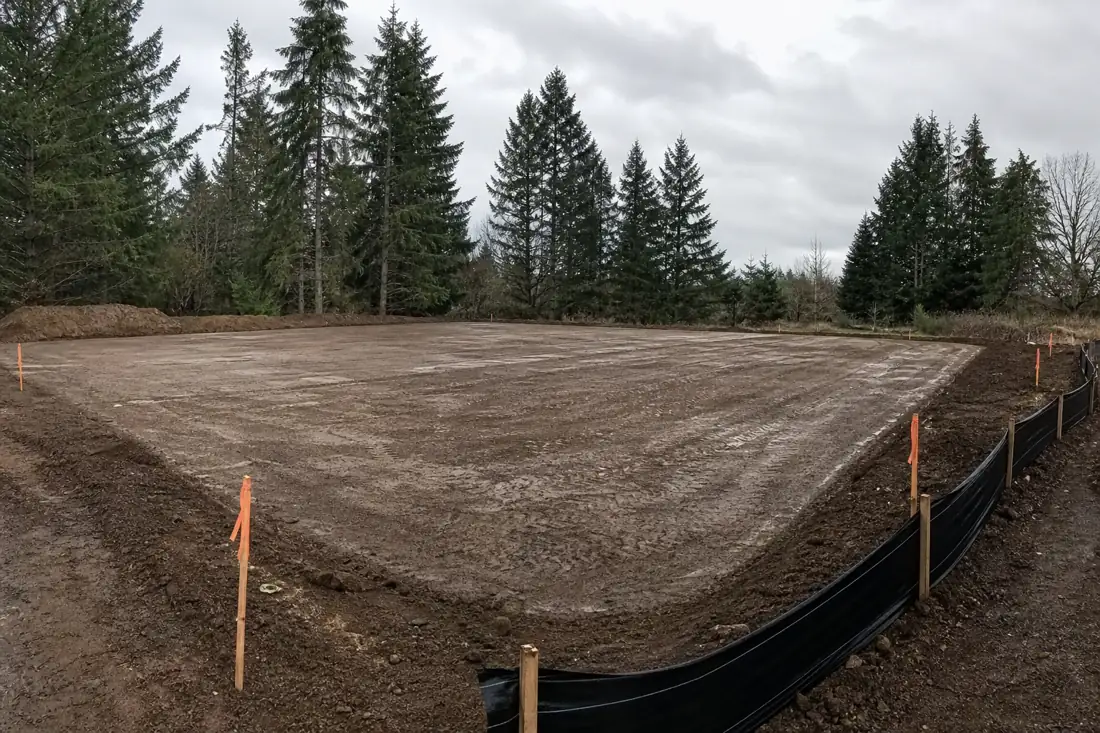
Excavator exposing buried fill and old foundation debris during
    site preparation in Forest Grove, OR
Exposing what is actually in the ground is the first step on any previously developed Forest Grove parcel.

What Site Preparation on a Previously Developed Parcel Actually Involves

On a site with prior construction history, the scope of site preparation cannot be fully defined at the estimate stage. Here is what the investigation and preparation process typically covers:

Every step above adds information that reduces risk on the back end. Working with excavation contractors in Hillsboro, OR who treat investigation as part of site preparation rather than an add-on keeps the project from stalling at the structural engineer’s inspection.

Why the Number Comes After the Investigation, Not Before

Owners who have received a flat-rate site prep quote on a Forest Grove parcel with construction history should ask what assumptions that number is based on. If the contractor has not seen the ground, the quote is built on assumptions about fill depth, fill type, and groundwater. When the excavation reveals that the fill runs four feet deeper than expected, or that it is mixed with wood and old concrete, the flat rate becomes a change-order conversation. Tualatin Valley silty clay is the native soil in this region, and when that material was disturbed decades ago and replaced with whatever was available, it does not behave like the surrounding undisturbed ground. Probing before quoting is not a way to avoid committing to a price; it is how an honest contractor builds a price that reflects what the work will actually cost.

Moisture and Fill — the Combination That Drives Cost

Saturated fill is heavy, slow to handle, and difficult to haul. When groundwater sits in old fill material, that material must often be dewatered before it can be removed efficiently, and the replacement structural fill must be placed in dry conditions to compact correctly. Our Hillsboro excavation equipment includes dewatering capability for exactly this reason. The cost of handling wet unsuitable fill is real, but it is a known, finite cost compared to the cost of a settled slab, a cracked foundation wall, or a failed inspection that stops a framing crew. Forest Grove’s history as a developed town since 1850 means every parcel has a story underground, and the only way to know that story is to look.

Scheduling, Permits, and Realistic Cost on Forest Grove Sites

Site preparation on a previously developed Forest Grove parcel is permitted through Washington County. If the ground disturbance reaches or exceeds one acre, the Oregon DEQ 1200-C stormwater permit applies, and an erosion-control plan is required before work begins. Clean Water Services imposes erosion-control requirements on disturbances smaller than one acre as well, so the plan is rarely optional regardless of project size. Permit lead time is a scheduling factor, and owners who try to skip the investigation phase to move faster often find that a buried surprise adds more time to the schedule than a methodical start would have. The wet season runs October through May in the Tualatin Valley, and certain fill-handling and compaction operations are more difficult in standing water, so sequencing work to stay ahead of the rains is part of competent site planning here.

Actual cost on a Forest Grove previously developed site is a function of what the investigation finds: fill depth, fill type, groundwater depth, and whether buried structures exist. The Hillsboro excavation crew can provide a realistic cost range after seeing the site and opening a test pit, and that range will be far more useful to your project budget than a number produced from a satellite view and a guess. We call 811 before any probe and we document what we find so there are no surprises between the estimate and the final invoice.

Excavation Services We Provide in Forest Grove

Forest Grove excavation projects often involve ground that has been disturbed, filled, and built on before. See the full range of services from excavation contractors in Hillsboro, OR.

Drainage & French Drains

Drainage & French Drains →

Site Preparation

Site Preparation →

Utility Trenching

Utility Trenching →

Grading & Leveling

Grading & Leveling →

Frequently Asked Questions

Why can’t you give me a fixed price before you dig on my Forest Grove lot?

Because the price depends on what is underground, and we do not know that until we open the ground. Old fill can run two feet deep or eight feet deep. It can be clean gravel or mixed debris with old concrete. Groundwater can be absent or a foot below grade. Each of those findings changes the scope. A quote built on assumptions is a setup for change orders. We give you a range after we investigate, and we narrow that range as the excavation proceeds.

How do you know the old fill has to come out?

We know because fill placed without engineering specifications will not compact to a density that supports structural load without settling. When a slab or foundation settles unevenly, it cracks. The only reliable fix is removal and replacement with material placed in controlled lifts and tested for compaction. Probing the fill and observing how it behaves under machine weight tells us whether it is marginal or clearly unsuitable.

Does groundwater always mean dewatering?

Not always, but it means we observe and plan for it. If groundwater appears in the test pit above the intended pad subgrade elevation, we need to either lower the pad, install sub-drainage, or dewater during excavation. Ignoring groundwater and placing fill anyway produces a wet subgrade that will not compact correctly and will remain unstable. The observation is free; the surprise later is not.

What happens to the unsuitable fill you remove?

It is trucked off site to an approved disposal or recycling facility. Concrete rubble goes to a crusher. Mixed organic and soil material goes to a fill acceptance site or compost facility depending on content. We haul clean native soil elsewhere on the parcel if there is a use for it. Nothing is buried back into the pad area.

What does site preparation cost on a previously developed Forest Grove parcel?

The honest answer is that it depends on what the investigation finds. A site with shallow fill and no groundwater costs significantly less than one with four feet of mixed debris over a rising water table. After a site visit and test pits, we can give you a realistic range broken into a base scope and conditional items tied to specific findings. That approach takes a day longer than a phone-quote but produces a budget that does not blow up at the first unexpected discovery.

How does the DEQ 1200-C permit affect a Forest Grove site prep project?

If your project disturbs one acre or more of ground, Oregon DEQ requires a 1200-C stormwater permit before work begins. Smaller disturbances still require Clean Water Services erosion-control compliance. Both require an erosion-control plan that identifies how sediment will be contained on site. We help owners understand which threshold applies and what the plan needs to cover before we schedule the first machine.

Get Your Free Hillsboro Excavation Estimate

Tell us about your project and we will come walk the site and give you a straight, itemized quote — no obligation, no pressure. Call us, or send the form and we will get back to you the same business day.

We only use your info to contact you about your project. No spam, ever.

Prefer to talk?

Call or text and reach us directly. We answer during business hours and return every message.

(971) 397-9361

Hours: Mon–Sat, 7am–6pm