Serving Hillsboro & all of Washington County, OR Free estimates: (971) 397-9361
Hillsboro Excavation Co.

Home › Banks

Utility Trenching in Banks, OR

Trenching in Banks means working inside a tight street grid one day and crossing open farm ground the next—two environments with different logistics but the same need for correct bedding and compaction.

Licensed & insured in Oregon Free on-site estimates Local Washington County crew Wet-season ready

Utility trenching in Banks, Oregon means managing two very different job environments within the same service area. Inside city limits, a 0.37-square-mile street grid and a population of 1,837 people create tight lots, narrow rights-of-way, and almost no room for equipment staging or spoil storage. Beyond city limits, the lots open into agricultural parcels that carry decades of unmarked drainage infrastructure beneath the surface. Hillsboro Excavation Co. approaches each environment with the same fundamental discipline—know what is in the ground before you cut it—while adjusting the logistics for whichever setting the job lands in.

Banks also sits at the southern end of the 21-mile Banks-Vernonia State Trail, a corridor used by cyclists, hikers, and equestrians. Any work near that corridor or near a shared utility easement carries a practical obligation to keep access safe and unobstructed throughout the job. That constraint is not unusual for utility work in general, but it is especially present in Banks because the trail’s southern trailhead sits at the edge of the small downtown area, making it easy for a residential or commercial trench job to end up adjacent to an active public right-of-way without the crew fully accounting for it at the planning stage.

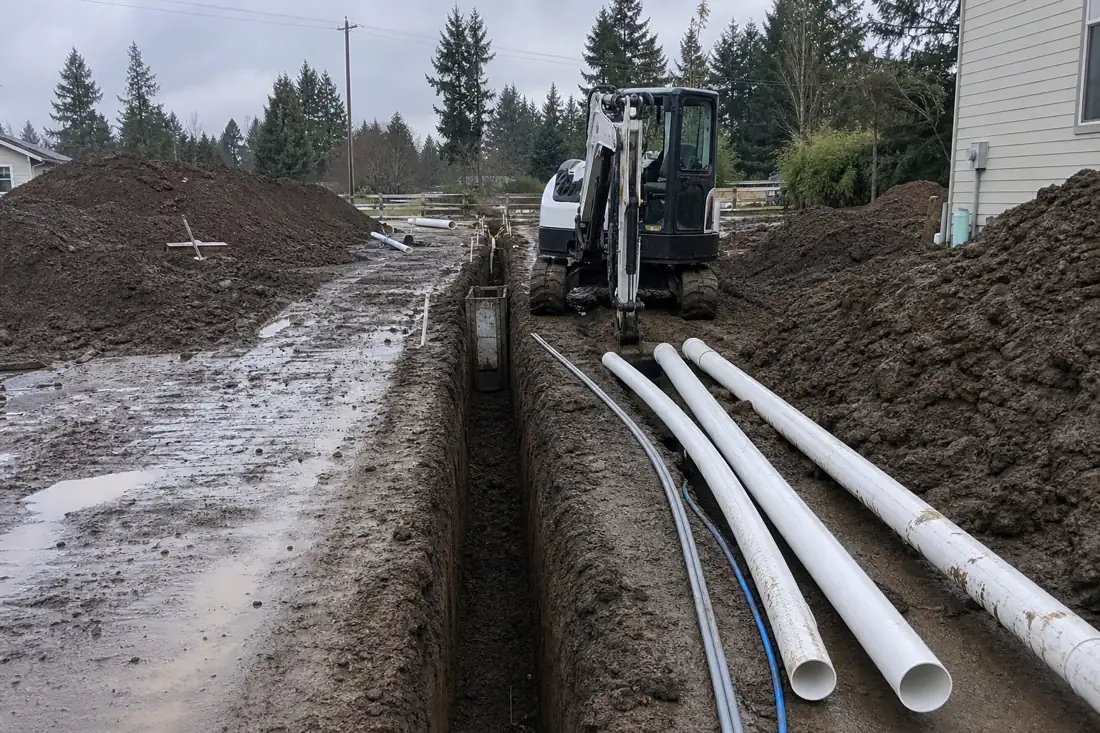
Open utility trench with pipe bedding material on a small-town Oregon lot near agricultural land
Proper bedding and compacted backfill in a trench prevent the surface settlement that turns a clean utility installation into a rutted driveway crossing the following winter.

What Utility Trenching in Banks Requires Step by Step

Every trench job in Banks involves the same core sequence, and the constraints specific to this town push each step in a direction that differs from how the same work might run on a larger, more open lot in another part of Washington County.

These are not optional steps that get added when a client asks for a premium job. They are the baseline that prevents callbacks, protects the access for trail and road users, and keeps the installation functioning through the first winter. Excavation contractors in Hillsboro, OR who work across both urban and rural Washington County settings know that skipping any one of them creates a problem that costs more to fix than the step cost to do correctly.

Soil Conditions and Unmarked Infrastructure Around Banks

The Tualatin Valley silty clay that underlies most of northwestern Washington County holds moisture for weeks after the last rain. During the Oct-May wet season, the water table rises close enough to the surface that a trench left open overnight can take on water, destabilize the walls, and make the pipe bed soft enough to allow movement after backfill. That is not a seasonal inconvenience to plan around—it is a design input. Trench depth, shoring if needed, bedding material, and the schedule for each lift of backfill all depend on how wet the ground is at the time of the cut. Basalt rock also appears a few feet down in parts of Washington County, and when it shows up in a trench that was scoped expecting soil, the equipment and approach have to adjust on the same day.

What Unmarked Farm Infrastructure Means for a Trench Plan

Agricultural land around Banks has been in continuous production for generations. The drainage systems that make that land productive—clay tile drain lines installed to lower the water table, field drainage connections that route water to county drains, old irrigation mains serving outbuildings or field hydrants—were put in before systematic record-keeping and have never been entered into any utility database. Striking an active tile drain in October, just before fall planting, cuts off field drainage for the entire wet season. Finding it with a probe rod before the bucket enters the ground takes fifteen minutes per run and prevents a problem that can take several weeks to repair. The same methodical approach that informs our Hillsboro excavation work on complex urban sites translates directly to this kind of private-infrastructure mapping on farm parcels.

Permitting, Scheduling, and What Banks Trench Jobs Cost

Utility trenching in Banks generally requires a Washington County right-of-way permit for any work in the public right-of-way, a connection permit from the applicable water or sewer district when the trench ties into an existing main, and in cases where total soil disturbance reaches one acre or more, an Oregon DEQ 1200-C stormwater permit with an erosion-control plan that meets Clean Water Services standards. A single residential lateral in town rarely approaches one acre of disturbance, but a longer agricultural run that follows a fence line or crosses a field can exceed it depending on route length and how much staging area is disturbed alongside the trench corridor. Getting the permit scope right at the outset keeps the job from stopping mid-cut for a permit amendment.

The line item that surprises property owners in Banks most often is spoil hauling. On a suburban lot in a larger city, excavated material might stay on-site and get reused as backfill or graded away. In Banks’s compact right-of-way, there is nowhere for it to go, and leaving it in the street is not an option. The Hillsboro excavation crew quotes spoil hauling as an explicit, itemized line so the number is visible before work starts rather than appearing as a change order after the trench is open. Scheduling in the dry season—June through September—reduces the risk that a freshly backfilled trench gets saturated before compaction sets, but utility failures happen year-round, and when a pipe breaks in February, the trench gets dug in February.

Excavation Services We Provide in Banks

Banks utility trench work spans in-town laterals and agricultural runs—reach the excavation contractors in Hillsboro, OR who know both settings.

Drainage & French Drains

Drainage & French Drains →

Site Preparation

Site Preparation →

Utility Trenching

Utility Trenching →

Grading & Leveling

Grading & Leveling →

Frequently Asked Questions

Does Hillsboro Excavation Co. dig utility trenches inside Banks city limits?

Yes. We work on residential water and sewer laterals, electrical conduit runs, and communications trenching on in-town lots in Banks. The compact street grid means spoil gets hauled off rather than stockpiled on-site, and every job includes restoration of any driveway or paved surface the trench crosses. We pull the required Washington County right-of-way permit and any utility-district connection permit before work starts.

How do you locate underground lines on farmland outside Banks where 811 has no records?

Oregon 811 marks publicly recorded utilities only. Agricultural infrastructure around Banks—old drain tile, field irrigation mains, private drainage connections to county drains—never made it into any utility database because it was installed as private farm infrastructure. We locate those lines by probing with a rod along the likely run before any excavation begins, marking what we find, and adjusting the trench alignment if a live drain crosses the planned route. It adds time at the front of the job and saves a much larger problem later.

Why can’t excavated spoil stay on-site during a Banks utility trench job?

Banks’s 0.37-square-mile street grid leaves almost no room between the trench and the property line, adjacent driveways, or the edge of the road. Piling spoil in the right-of-way blocks the lane and creates a liability; piling it on-site often means it ends up on a neighbor’s property or in a drainage swale. We load it as it comes out and haul it the same day. That cost is quoted as a separate line item so it is visible in the estimate rather than appearing later as a change order.

How close can you trench to the Banks-Vernonia State Trail corridor?

Setback requirements depend on which entity holds jurisdiction over the segment of trail and whether the trench is in the trail easement, adjacent to it, or simply nearby. Work within the easement requires prior authorization from Oregon Parks and Recreation or Washington County, depending on the segment. Work adjacent to it requires maintaining safe, unobstructed access for trail users at all times. We establish the applicable setback before mobilizing rather than discovering it after the equipment is on-site.

What does utility trenching cost in Banks, OR?

Trench cost depends on depth, pipe diameter, native soil conditions, pipe-bedding material, and whether basalt is encountered below the soil layer. In Banks, spoil hauling adds a line item that does not appear on jobs with room for on-site stockpiling. Longer agricultural runs that probe and map private farm drainage lines before cutting add field time that is not part of a simple residential trench. We quote those factors separately so the total is accurate before work begins rather than being adjusted after the trench is open.

What permits are required for utility trenching in Banks?

Right-of-way work in Banks requires a Washington County permit. Connections to an existing water or sewer main require a connection permit from the applicable district. Projects disturbing one acre or more of soil—uncommon for a single residential lateral but possible on longer agricultural runs—trigger an Oregon DEQ 1200-C stormwater permit that requires an erosion-control plan meeting Clean Water Services standards. We identify which permits apply to your specific job scope during the estimate and handle the applications before the crew mobilizes.
Get Your Free Hillsboro Excavation Estimate

Tell us about your project and we will come walk the site and give you a straight, itemized quote — no obligation, no pressure. Call us, or send the form and we will get back to you the same business day.

We only use your info to contact you about your project. No spam, ever.

Prefer to talk?

Call or text and reach us directly. We answer during business hours and return every message.

(971) 397-9361

Hours: Mon–Sat, 7am–6pm