Home › Forest Grove
Forest Grove has been platted since 1850, which means the ground beneath it is layered with pipes, conduit, and abandoned service lines that predate modern locating standards.
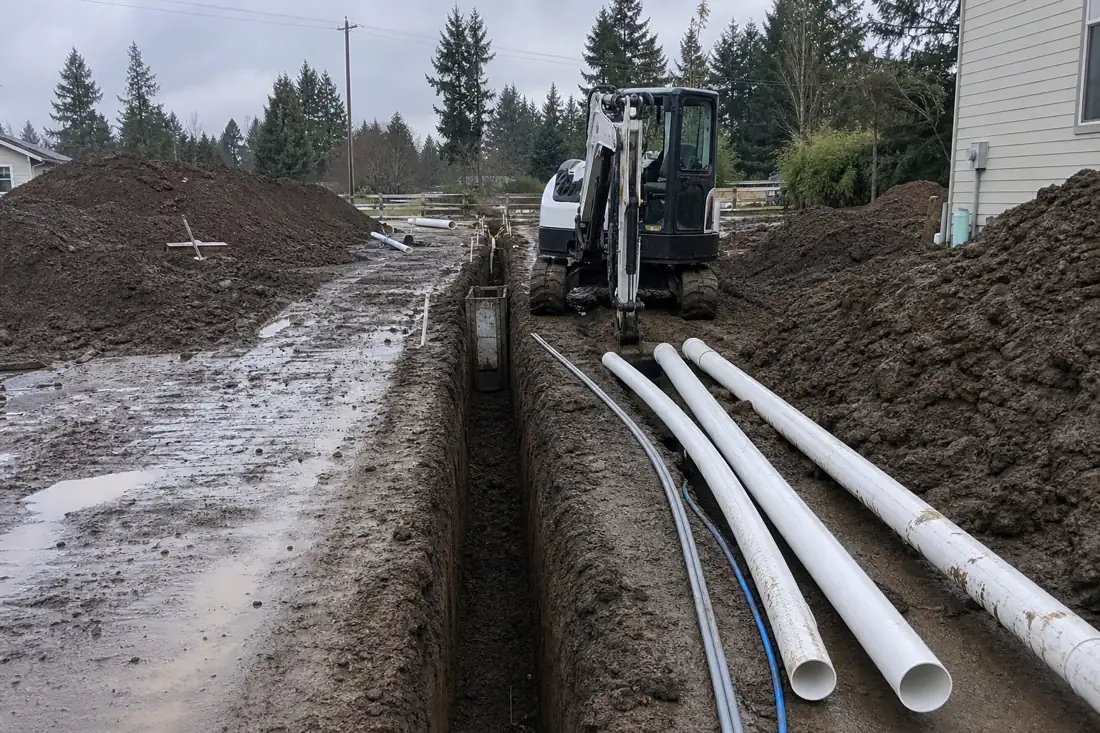
Utility trenching in Forest Grove, OR means opening ground that may have been disturbed a dozen times since the town was platted in 1850. Water mains, gas service lines, electrical conduit, and private drainage pipes have been laid, repaired, rerouted, and abandoned over more than 170 years, and very few of those older installations were recorded at the accuracy modern locating equipment expects. Hillsboro Excavation Co. approaches every Forest Grove trench job with that history in mind, treating the ground as already occupied until the excavation proves otherwise.
Forest Grove covers 5.88 square miles total, of which 0.14 square mile is surface water. Any trench within several hundred feet of those water features will intersect a water table that rises sharply through the October-to-May wet season. Silty clay soils typical of the Tualatin Valley hold moisture and do not drain freely, so an open trench can fill overnight after a heavy rain. Dewatering is not an afterthought here; it is a routine part of keeping the trench walls from sloughing and keeping the bedding material dry enough to compact properly.
Forest Grove’s age means each trench job requires extra verification steps before machine work begins. The checklist below reflects what a responsible crew does on a site where the ground has been worked before and records are incomplete.
These steps add time, but skipping them trades a small schedule gain today for a settled surface, a struck pipe, or a flooded trench tomorrow. Every crew sent out by excavation contractors in Hillsboro, OR follows this sequence on Forest Grove jobs regardless of how routine the project appears at the start.
The 811 call-before-you-dig system locates utilities that are registered with Oregon 811 — typically active public mains for gas, electric, telecom, and water. It does not locate private service lines running from the main to a building, it does not locate abandoned pipes that were cut and left in place rather than removed, and it does not locate utilities installed before modern depth standards were adopted. In Forest Grove, where platting began in 1850 and service infrastructure was added piecemeal over many decades, a blank locate ticket is not confirmation that the ground is clear. It is confirmation that the ground has no registered active utilities — a meaningfully different statement. Crews that treat those two things as equivalent are the ones who end up cutting a live line or punching through an old clay drainage pipe and flooding their own trench.
With 0.14 square mile of surface water within Forest Grove’s boundaries and the Tualatin Valley’s high winter water table underneath, a trench that stays open more than a day commonly encounters groundwater infiltration. Silty clay soils swell when wet and can lose bearing capacity quickly, which destabilizes trench walls and contaminates crushed-rock bedding with fine particles that prevent proper compaction. A dewatering pump running continuously during pipe placement is not oversized caution; it is the minimum necessary to keep the bedding layer dry and the walls stable. Clean Water Services erosion-control rules also apply to any disturbed soil near waterways, so discharge from dewatering must be filtered before it leaves the site. Our Hillsboro excavation team carries the equipment and knows the discharge requirements before the job starts.
A utility trench in Forest Grove typically requires a right-of-way permit from Washington County or the city if the trench crosses or parallels a public street, and a Clean Water Services service provider letter if grading will disturb vegetated buffers near surface water. Oregon DEQ’s 1200-C stormwater permit applies when the total disturbed area reaches one acre or more, which is uncommon on a single utility run but relevant on larger site jobs that include trenching. Permit timelines add days to a schedule, so applications should go in before mobilization is booked, not after the machine arrives on site.
Compaction is where Forest Grove trench work lives or dies long-term. The native silty clay backfill that gets returned to the trench above the bedding zone must be placed in lifts and compacted to a density that matches the surrounding undisturbed ground, or the surface — pavement, lawn, brick walk, or garden bed — will settle unevenly over the first wet season. On century-old properties, that settlement often destroys hardscape or drainage patterns that took decades to establish and cannot be replicated with off-the-shelf materials. The Hillsboro excavation crew uses a plate compactor or jumping-jack in the trench and a density test at the surface before calling the backfill complete, because a passed compaction test is the only way to know the ground will not drop.
Get a site evaluation from excavation contractors in Hillsboro, OR before assuming a locate ticket tells the whole story.
No. Oregon 811 locates only utilities whose owners are registered with the notification center and have active service. Private lines from the main to your building, abandoned pipes that were taken out of service but left in the ground, and any utility installed before registration was required will not appear on a locate ticket. In Forest Grove, where infrastructure has accumulated since 1850, those unlisted lines are common enough that we treat every trench as potentially occupied until potholing confirms otherwise.
Potholing means digging a small test hole by hand or with a vacuum excavator directly over a suspected utility crossing to expose the actual pipe or conduit and confirm its depth and position. We use it whenever a locate ticket shows a utility crossing our planned trench line, and whenever the site history suggests buried infrastructure that did not show up on the locate. It takes less than an hour per crossing and prevents the much longer delay of a struck line and emergency repair.
The Tualatin Valley water table rises through the October-to-May wet season and stays elevated in low areas near surface water. Forest Grove has 0.14 square mile of surface water within its 5.88 square miles, which keeps groundwater close to the surface in surrounding areas even during dry stretches. A trench that intercepts the water table will fill from the bottom regardless of recent rainfall. Dewatering pumps the groundwater out continuously while pipe is being placed so the bedding stays dry and compactable.
We use clean, angular crushed rock in the bedding zone rather than native soil. Tualatin Valley silty clay retains moisture and does not compact uniformly enough to support a pipe without long-term settlement. Crushed rock in the correct gradation for the pipe diameter is imported, placed in the trench, tamped in lifts, and tested before the pipe goes down. Above the bedding zone, native soil is returned and compacted in lifts to match surrounding density.
Cost depends on trench length, depth, soil conditions, and whether dewatering equipment is needed. An urban lateral in reasonably clear ground costs less per foot than a trench that requires potholing at multiple crossings, continuous dewatering, and hand work around existing tree roots or hardscape. We give fixed quotes after a site visit because Forest Grove’s variable subsurface history makes per-foot estimates unreliable until we know what we are actually dealing with underground.
A permit is typically required any time the trench crosses or opens a public right-of-way, connects to a public utility main, or disturbs soil within a Clean Water Services buffer near a waterway. Work entirely within private property that does not touch a public right-of-way may not require a separate trench permit, but the utility connection itself usually requires an inspection. Washington County and the City of Forest Grove each have permit offices; we identify which applies and what is required before the job starts.
Tell us about your project and we will come walk the site and give you a straight, itemized quote — no obligation, no pressure. Call us, or send the form and we will get back to you the same business day.
Call or text and reach us directly. We answer during business hours and return every message.
(971) 397-9361Hours: Mon–Sat, 7am–6pm